“Where [democratic socialism and communism] differed was in whether the government officials who were to wield this power [to control the nation’s economy] should be elected by the general public, as advocated by democratic socialists, or chosen by some autocratic process, including dictatorship, as advocated by communists.*
“Although both socialist and communist governments began by replacing market economies with centrally planned economies in the twentieth century, by the end of that century most democratic socialist governments and most communist dictatorships had abandoned central planning after experiencing its results. Then, as many economic decisions were transferred from government officials to private individuals and organizations operating in markets, the rate of growth of output usually increased — dramatically in India and China. In both of these countries, this lifted millions of people out of dire poverty, as had happened in various other countries before. Despite the Marxian premise that the poor are poor because they are exploited by the rich, none of the Marxian dictatorships around the world with comprehensive central planning ever achieved as high a standard of living as was common in various market economies in Western Europe, North America or in such Asian nations as Japan and South Korea.
“Despite the indispensability of government for some economic activities and its value for some other economic functions, the limitations of its ability to carry out some more sweeping economic activities under comprehensive central planning are not simply the limitations of particular individuals who wield power, but include inherent limitations on what power itself can accomplish.”
* “Other central planners include fascists, who allowed private ownership of the means of production, but with these owners subject to government dictates. In Germany, a special xenophobic form of fascism was called National Socialism, more commonly known by a contraction of this party’s name in Germany as Nazis.”
This article is written by Mark Horne, and is re-blogged from Theopolis.
What shall we say then? Is there injustice on God’s part? By no means! For he says to Moses, “I will have mercy on whom I have mercy, and I will have compassion on whom I have compassion.” So then it depends not on human will or exertion, but on God, who has mercy. For the Scripture says to Pharaoh, “For this very purpose I have raised you up, that I might show my power in you, and that my name might be proclaimed in all the earth.” So then he has mercy on whomever he wills, and he hardens whomever he wills.
You will say to me then, “Why does he still find fault? For who can resist his will?” But who are you, O man, to answer back to God? Will what is molded say to its molder, “Why have you made me like this?” Has the potter no right over the clay, to make out of the same lump one vessel for honorable use and another for dishonorable use? What if God, desiring to show his wrath and to make known his power, has endured with much patience vessels of wrath prepared for destruction, in order to make known the riches of his glory for vessels of mercy, which he has prepared beforehand for glory— even us whom he has called, not from the Jews only but also from the Gentiles? As indeed he says in Hosea… (Romans 9).
Ultimately, there is great mystery and terror in contemplating the infinity and power of God. The fact that he knows and plans all things, the fact that he “works all things according to the counsel of his will,” cannot be escaped. Trying to solve the problems this seems to bring by making the ultimate plan to be what falls together from the conglomeration of human choices simply transfers mystery and terror from God to “reality,” “the universe,” or some other title for the metaphysical casino that results when we make ultimate reality impersonal rather than personal…
“We are shareholders in the truth whenever we think. But thought is and must be, by its very essence, dialectical. Being a shareholder, the individual mind never owns the whole capital of truth. We are thrown on others; our thought provokes other and contrary thought! On the bare physical plane one individual or group can easily cope with the life of many other groups and individuals: indifference and peaceful equilibrium are possible at that level. But thought changes the peace of the world. Thought is always provoking its own contradiction. This eternal dialogue of thoughts and principles organizes humanity into schools of thought. The parties of policy, the armies of war, and the classes of interest, are embodiments of this power of the mind to act like a sword, to distinguish and to polarize, to live by paradox and conflict, by dialectical revolutions.”
Why is there poverty in the world? Is there not enough wealth for everyone? Some believe that the resources which produce wealth are fixed, but there is enough for everyone. Those people tend to also believe that wealth must be collected by a benevolent force, like government, and distributed fairly.
Others believe that wealth is created and the resources which are used to do so are not fixed or limited. As humanity gains knowledge about the world around us, we are able to convert more and more new kinds of resources into wealth. The key is having the skills and knowledge to do so.
But what about poverty? How can poverty be abolished once and for all? Is that even possible?
One idea is called “Basic Income” or “Guaranteed Income”. Here’s a video from Vox presenting the idea…
You can read the full article how Vox lays out this program here. But basically they say this:
“‘Basic income’ is shorthand for a range of proposals that share the idea of giving everyone in a given polity a certain amount of money on a regular basis. A basic income comes with no categorical eligibility requirements; you don’t have to be blind or disabled or unemployed to get it. Everyone gets the same amount by virtue of being a human with material needs that money can help address.”
“A basic income is the best policy idea you’ve never heard of. The idea is simple: instead of, or in addition to, the panoply of government transfer programs currently in place, we just give everyone in the country a set amount of money per year, no strings attached. The benefit could phase out as one’s income rises (this variant is known as a ‘guaranteed minimum income’) or could just be granted unconditionally: you get $10,000 a year, I get $10,000 a year, the poorest of the poor get $10,000 a year, Bill Gates gets $10,000, etc.”
Milton Friedman is mentioned in the Vox video as being someone who supported “Basic Income”. But, according to the two definitions above, that’s not necessarily true. Whereas the definitions above call for everyone to receive a certain amount of money, regardless of pre-existing wealth or lack thereof, Friedman proposed a system called “Negative Income Tax” (NIT). NIT only provides money to those who are poor and are in a tax bracket where, instead of paying taxes, they receive a negative tax. Also, with Friedman’s plan, the amount they receive is not necessarily enough to live on, but rather, would be an incentive for them to work and generate their own higher income. He lays out his plan here…
Friedman was against the welfare program, and he saw his NIT program as an answer to welfare.
The New York Times also wrote about Friedman’s plan. The following opening quote from the Times article shows that they either didn’t understand Friedman’s plan or were pushing their own agenda. Probably the latter.
“Milton Friedman, who died last week at 94, was the patron saint of small-government conservatism. Conservatives who invoke his name in defense of Social Security privatization and other cutbacks in the social safety net might thus be surprised to learn that he was also the architect of the most successful social welfare program of all time.”
NIT was not proposed by Friedman as a welfare program. And, how can the Times say it was the most “successful social welfare program of all time” when it was never tried?
Friedman discusses welfare, poverty, and equality here…
Poverty is not just a problem of insufficient cash, as the Vox video suggests. The Vox video states that the solution to people not having enough money is to give them money, and that the tool to eliminate poverty is cash. Well, there’s a lot more to it than that.
“Human Capital” is essential to eliminating poverty. Human capital can be defined as the skills and knowledge of people to create and sustain wealth. The post-WW2 reconstruction of Europe can be used as an example. Billions of dollars were given by the USA to help in the reconstruction. And, the European nations did rebuild successfully. Billions of dollars have also been given to third-world nations over the decades, but yet, they remain poor. Why the difference? Europe, despite being devastated by war, still had its human capital, whereas the third-world nations never had the human capital in the first place.
Another example which follows the same logic… Cambodia was decimated by the Khmer Rouge in the late 1970s. Afterward, the United Nations decided it would use Cambodia as a test experiment to use UN dollars to establish a democratic government. Somewhere around three billion dollars were spent to accomplish that goal. Did it work? No, it did not. The human capital required to create and sustain a democratic system did not then, and does not yet today, exist in Cambodia.
Handing out free money without any incentive for the receiver to produce his or her own wealth is not any kind of solution — the poverty still exists and the poor are simply paid to remain poor. Increasing human capital, however, through education and the free-market system, is a historically proven method. People are very inventive, and the ability to create wealth out of what was previously considered to be valueless is our greatest asset. Where there is no incentive, there is no inventiveness.
“Tangible material wealth is only a conversion of pre-existing physical material into a form that is more valued by human beings. The ability [the skills] to do so is the real wealth [which is called human capital].
“Behind such skills are cultural values that give a priority to the acquisition of those skills — and new skills as the old ones become obsolete over time, making the mastering of new skills imperative.
“Different groups living in the same external environment can have very different productivity if their internal cultural values produce very different priorities as to what they want to do, and at what sacrifices of other things.”


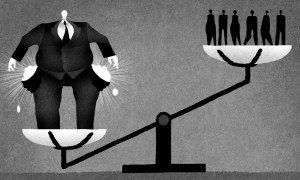 Why is there poverty in the world? Is there not enough wealth for everyone? Some believe that the resources which produce wealth are fixed, but there is enough for everyone. Those people tend to also believe that wealth must be collected by a benevolent force, like government, and distributed fairly.
 Pursuit of Percipience