Tribes, Kingdoms, and Empires (Part Two)

language

Tribes and Language

Our belief systems and capacity for knowledge are limited by our language. The smaller the vocabulary of a language, the less the adherents of that language are able to conceive of and develop new ideas. Like in the novel 1984 by George Orwell, the language of Newspeak was used to control the people, and this was done was by decreasing the vocabulary.

“‘It’s a beautiful thing, the destruction of words. Of course the great wastage is in the verbs and adjectives, but there are hundreds of nouns that can be got rid of as well. It isn’t only the synonyms; there are also the antonyms. After all, what justification is there for a word, which is simply the opposite of some other word? A word contains its opposite in itself. Take “good,” for instance. If you have a word like “good,” what need is there for a word like “bad”? “Ungood” will do just as well — better, because it’s an exact opposite, which the other is not. Or again, if you want a stronger version of “good,” what sense is there in having a whole string of vague useless words like “excellent” and “splendid” and all the rest of them? “Plusgood” covers the meaning or “doubleplusgood” if you want something stronger still. Of course we use those forms already, but in the final version of Newspeak there’ll be nothing else. In the end the whole notion of goodness and badness will be covered by only six words – in reality, only one word. Don’t you see the beauty of that, Winston?…'” (George Orwell, 1984, Book One, Chapter Five.)

I read an article recently about western psychiatrists working with post-Khmer Rouge Cambodians suffering from PTSD. The main frustration of the psychiatrists was that there were no words in the Cambodian (Khmer) vocabulary which properly defined the condition the patients were suffering from. The limitations of the Khmer language prevented the patients from fully understanding what they were experiencing.

Languages keep tribes divided. You can only know what your vocabulary allows for. This doesn’t just refer to your general spoken language – like English – it refers to your definition of certain English words and concepts in comparison to how other English speakers would define those same words and concepts. In order for tribes to combine into one, a common language, with common definitions, would have to be developed and adopted. A common language (words, beliefs, ideas) will create a common worship center as well, which is essential for a group of tribes to join.

Like at Babel, all the people spoke the same language, and as a result, they all worshipped the same and had the same philosophy of life. The division of languages not only caused confusion because they couldn’t understand each other’s words, it caused confusion also because they no longer believed the same way, thought the same way. This didn’t all happen at once of course, but over time the different languages created greater rifts between the tribes.

Once you’re limited to the vocabulary of a certain tribe, any new ideas coming from without the tribe will first have to be translated into your own tribal language. If there are no words to express the new ideas in your tribal language, you will either outright ignore the new ideas, or the new ideas will change to fit the language of your tribe. If the new ideas are changed to fit your language, they will also change to fit your current belief system. So, even if the new idea opposes your beliefs, once translated into your language, it will work to support your beliefs. The original intent of the idea will be lost.

Consider this example:

“‘Two African natives, S. and K., go to the wood to gather honey. S. found four big trees full of honey, whilst K. could find only one. K. went home bewailing his ill luck, while S. had been so fortunate. Meanwhile S. had returned to the wood to bring away the honey, was attacked by a lion and torn to pieces.

The relatives of the lion’s victim at once went to the soothsayer to discover who was responsible for his death. The soothsayer consults the oracle several times and declares that K., jealous of S’s rich harvest of honey, assumed the form of a lion in order to avenge himself. The accused denied his guilt strenuously and the chieftain ordered the matter to be settled by the ordeal of poison. Matters then followed their usual course — says the explorer’s account — the ordeal was unfavourable to the accused, he confessed and succumbed to torture… The accusation appears quite natural to the soothsayer who formulates it, the prince who orders the trial by ordeal, the crowd of bystanders and to K. himself who had been transformed into a lion, in fact to everybody except the European who happens to be present.’

It is clear to us that K. had not actually experienced turning into a lion and tearing S. to pieces, and so at first he denied having done so. But he is confronted with an overwhelming case against himself. The interpretative framework which he shares with his accusers does not include the conception of accidental death; if a man is devoured by a lion there must be some effective reason behind it, such as the envy of a rival. This makes him an obvious suspect and when the oracle, which he has always trusted, confirms the suspicion he can no longer resist the evidence of his guilt and he confesses having turned into a lion and having devoured S. This closes the circle of the argument and confirms the magical framework in which it was conducted, and it thus enhances the powers of this framework for assimilating the next case which will come under its purview.” (Taken from The Stability of Beliefs by Michael Polanyi.)

Within the confines of a tribe’s language, there will be its own justice system. No matter how nonsensical it may appear to the outsider, even the accused will agree with a verdict against him as he himself holds to the same belief system as his accusers. Tribes are bound within their own circular reasoning. New ideas are not able to penetrate this reasoning from without, nor are they able to take seed and grow from within. Only the presuppositional beliefs of the tribe will survive.

In order for new ideas to form within tribes, a systemic logic must be formed to support those ideas. New ideas, all alone, presented to the tribe on a one by one basis will not take root; they will not be understood. A new idea must be built on the framework of less radical pre-existing ideas, and those built on even less radical pre-existing ideas, and so on. This is the systematic step ladder on which the new ideas can climb.

True ideas must last, and false ideas must disappear. For this to happen, ideas cannot remain vague. They must be defined and then put to the test in practical reality. If the idea stands up to the test it will remain.

I can use “speaking in tongues” in Charismatic churches as an example. Most Charismatics have only a vague idea of what they’re doing when speaking in tongues. There is no agreed-upon definition of what tongues truly is within the Charismatic church. Some say there are two different kinds of tongues, others say three, some say one and what modern Charismatics do today is what the disciples did in Acts 2. Some say one does not have the Holy Spirit if they don’t speak in tongues, others would disagree with that, but would say that one is a less mature Christian without tongues.

Tongues is a tribal marker. It is a circular belief within Charismatic theology. In order to determine if it is a true idea or not, first it must be clearly defined within the entire Charismatic movement, then it must be practically applied to the personal lives of the members of the tribe. It will either disappear or its true purpose will be discovered. If it is a true idea and its purpose is clearly known, it can then be an idea which can pass on to other tribes as it is no longer merely a tribal marker. As long as tongues remains vague, its true nature will not be discovered, and it will remain a simple tribal marker easily rejected by non-Charismatic tribes.

The language of the Charismatic church prevents itself from discovering the true nature of tongues. In fact, tongues itself is an unintelligible “language”. Is there a vocabulary to tongues? Are there rules of grammar? If there were, the language could be translated. What can tongues say about itself? Do Charismatics speak in tongues because they have nothing to say?

One can choose his own tribe or one can be chosen for a tribe. To choose, one must increase his vocabulary to the point where he understands a wide range of ideas. He can then choose which ideas he thinks are best for his well being. With a limited vocabulary comes a limited mind, and limited options.

Tribes, Kingdoms, and Empires – Part One

Tribes, Kingdoms, and Empires (Part One)

Tribal-MarkTribal Markers

Some ideas and beliefs we hold allow for some give and take. Other ideas, however, no matter how much our opponents logically refute them, we hold on to as though our whole self-identity depended on them. Which, they do. These are our tribal markers.

How do you know your tribal markers? If you’re in a debate about what you believe, and you are willing to cede some of your arguments to your opponent, then those particular beliefs are not foundational to your identity. But, if you and your opponent reach a point at which you have no other argument to offer than to say, “You just don’t understand. My people understand. We will just have to agree to disagree.” Then you have found your tribal marker.

For example, Charismatic “speaking in tongues” is one such tribal marker. Speaking in tongues is not essential to being a christian, but it is essential to being a Charismatic. If one stops doing it, one is no longer a Charismatic. It is essential to the identity. A Calvinist’s “predestination” beliefs are tribal markers as well.

The more radical the marker, the smaller the tribe, and the less one has to use logical thought to defend it. The more a group insists upon and refines a tribal marker, the more people will be excluded from the group.

Part Two

In Relationship (Part Six)

trinity1Trinity Vs. Triangulation 

“A real Christian is a person who can give his pet parrot to the town gossip.”

~Billy Graham

Do you have any relationships which are entirely based on gossip?

I remember a few years back starting a new job at a fairly large construction company. I was already a fully licensed electrician but the owners had me work along side some long-time employees so that I could learn the ropes as to how things ran at this particular company.

I was surprised at the amount of gossip and dissension I heard from these guys. They would talk bad about each other and talk even worse about the owners. When I was with employees A and B, they would bash employee C. When I was with B and C, they would bash A. This would go on day after day, the same conversations over and over again.

After a time I was given my own work truck, my own helper, and my own jobs — I no longer had to work with these guys. Five years later we hit a slow period and the owners put different crews together on the same jobs to keep everyone working. Once again I was working along side these gossipers. It was a shock to me to hear them still having the same conversations, still bashing each other behind their backs, still with the same complaints about the owners. After five years nothing had changed! Actually there was one noticeable change — all of them had more grey hair. I remember thinking, “These guys are stuck in kind of hell”.

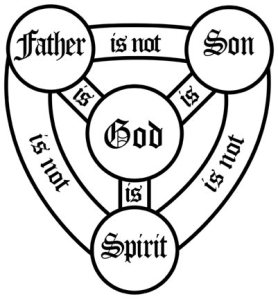
Begotten from the Father came the Son, and a relationship exists between the two. That relationship is the third person of the trinity: the Holy Spirit. (See Jonathan Edward’s essay on the trinity.)

Within the trinity, all three members (Father, Son, and Holy Spirit) are giving themselves to the other members. The Father does everything He does for the Son. The Son does everything He does for the Father. The Holy Spirit does everything He does for the Father and the son. This is a covenant relationship, the first covenant relationship. All true covenant relationships are based on the trinity.

But what would happen if the Father and the Son got together to attack the Holy Spirit? Or the Spirit and the Son to attack the Father? The God of the bible would be no more, and all that exists would be no more. God’s own relationship within Himself is essential for all life.

When I and another have a common enemy, even if he and I would not ordinarily form a relationship, we will form a relationship for the purposes of attacking our common enemy. This is called triangulation.

The best and most common example of triangulation I can give is the one of gossip above. Two people, whose relationship is based solely on the attack of a third person, joining forces for only as long as the third person is a threat. Once the third person is gone, the relationship is over. This is anti-relationship.

The problem with gossip is that it is so compelling. What better way to boost yourself up than by bringing another down, especially when the other is not even able to defend themself at that.

That life only leads to misery. Better to give yourself in a covenant and live than die in the loneliness of triangulation.

In Relationship ~ Part One; Two; Three; Four; Five

In Relationship (Part Five)

goldenwizard10

Rules and Expectations

“There are no rules of architecture for a castle in the clouds.”

~G.K. Chesterton

I have three rules for my kids: No fighting. No crying unless you’re genuinely hurt. Don’t touch my stuff. Apart from that they pretty much have free reign. A pastor friend once told me that at his old house he had a large backyard. At first there was no fence around the yard and he noticed his children would only play near the house. Soon after he built a fence, and the children began to play all over the yard. Once they knew where it was safe to go, they were free to enjoy the whole area.

We need to know the rules of the game if we are going to be able to function in our relationships. Have you ever broken a rule, but didn’t know that you broke it until after you broke it? Have you ever been in a situation where the rules were not equally applied to each person? It’s frustrating isn’t it? It fact, it can be maddening.

“Even more than they need goods, people want for their contentment a full understanding of their condition. None can find comfort in a position which he fails to comprehend, and protracted perplexity leads to mental derangement.

Perplexity of Rats and Dogs

“Even rats and dogs cannot live in perplexity. Take three sets of rats: give one set a meal a day; give the other set the same meal only every second day; and restrict the third group to a meal on every third day. All three groups will thrive; the rich, the middle-class and the poor will get on equally well. But take a fourth set of rats and feed them at periods varying irregularly between one and three days and you will see the rats of this set die. They get more than the poor rats, yet while those prosper on their meager diet they perish because their organism is thrown into a state of confusion, all their reflexes of digestion are dislocated, they die of perplexity.

“Dogs are more human than rats, and so the experiment by which Pavlov drove his dogs mad shows us even more closely what is wrong with ourselves. He trained a dog to expect food when a luminous circle appeared on a screen, and to recognize that no food would come when a flat ellipse with a ratio of semiaxis 2:1 was produced. The dog learned to differentiate precisely between the circle and the ellipse, showing signs of appetite when the former, not when the latter was shown. The shape of the ellipse was then approximated by stages to that of the circle (ratios of the semiaxis 3:2, 4:3 and so on) and the training of discrimination continued through the successive ellipses. The dog found it increasingly difficult to distinguish between the ellipses and the circle and finally, when the ellipse was given a ratio of 9:8 he became quite uncertain in his discrimination. But Pavlov tried to educate him to the limit and continued with this experiment for three weeks. The result, however, was no improvement in the dog’s training but a total breakdown of his discriminating power. At the end he could not see the difference even between the flat 2:1 ellipse and the circle. The dog’s behaviour also underwent a complete change. It began to squeal in its stand, kept wriggling about, tore off with his teeth the apparatus and bit through various tubes. In short, as Pavlov says, it fell into the condition of an acute neurosis.

“This dog broke down when his powers of understanding were overstrained. They were overstrained when it became too difficult for him to distinguish between the symbols signifying food and hunger. His happiness was destroyed, not by need of supplies but by what Pavlov describes as a conflict between excitation and inhibition which its brain found too difficult to resolve.” (Taken from Visual Presentation of Social Matters by Michael Polanyi.)

If I can’t predict the actions of the other parties in a working relationship, I cannot pursue any of my goals. The relationship breaks down, and I will most likely leave, but not after suffering much frustration.

A contract protects people from this ever happening. A covenant does as well, but for different reasons. In a contract there is a “higher power” (the law court) which can be appealed to if one party does not fulfill its predicted duties. In a covenant, each party is at all times fully giving themselves to the other, so there is nothing unpredictable about it.

The problem of unpredictability can really only happen in one of two kinds of relationships: charity or master/slave — where one party holds all the resources over the other. A slave does not have any options in this situation. A receiver of charity, however, can move on to find new donors.

In Relationship ~ Part One; Two; Three; Four; Six; Seven

In Relationship (Part Four)

covenant-quotes-001The Rarity of Covenants

“Asking for a definition of ‘covenant’ is something like asking for a definition of ‘mother'” 

~O. Palmer Robertson

Covenant is not a word to take lightly. If you say you are in covenant with someone, you’d be wise to know exactly what you are saying.

It’s easy to imagine a perfect circle. You can talk about it, analyze it, and theorize about it. But, until you actually draw it, it is just an idea. How many times do we come up with great ideas and then just stop there thinking our work is done. Ever been to a board meeting?

It is the same with the idea of covenant. It is easy to talk about, but extremely difficult to do. Covenants are rare.

So who actually enters into covenants? Families do: husbands and wives, parents and children, brothers and sisters, etc…

Members of organizations do not enter into covenants. They can say they do until their faces turn blue, but all you have to do is observe their actions for a little while and you’ll see that it is not true. Until one is willing to become family to another, he will be in a contractual relationship, or any other kind of relationship other than covenant.

Outside of covenant, before vision, before passion, and before loyalty, one is motivated by selfish desires. These selfish desires are not evil in and of themselves, they are naturally human. When these selfish desires lead one to do evil things, then they become harmful. But, how many people, who have done good and noble things, have not started out with selfish desires?

One member of an organization can say he’s in covenant with another. He can say that he values the success of the other over his own. He can hold himself as an example of what healthy covenants look like. He can do all that talking, but really he is putting his own selfish desires first. And that’s okay, as long as he is honest about it.

Charles Spurgeon said, “Sincerity makes the very least person to be of more value than the most talented hypocrite.” Even though one cannot be perfect in his covenant vows, if he is sincere in his actions he is a true covenant keeper. One who merely says he is in covenant, but does not act accordingly, is nothing more than a hypocrite.

This is especially true for leaders. Leaders have the “raw end of the deal” in the covenant. Like God, they have to be the better, stronger member of the covenant. Like God, it is up to them to define the terms of the covenant. Our covenants with each other must image God’s covenant with us.

“A covenant is a bond in blood sovereignly administered. When God enters into a covenantal relationship with men, he sovereignly institutes a life-and-death bond. A covenant is a bond in blood, or a bond of life and death, sovereignly administered.” (O. Palmer Robertson, The Christ of the Covenants [Phillipsburg, NJ: Presbyterian and Reformed Publishing, 1980], pg. 4)

Robertson gives three main attributes to a covenant:

  1. It is a bond — Covenant members are bound together in relationship and this bond is sealed with a binding oath (sometimes verbal, sometimes by symbolic action) by both parties. No oath = no bond = no covenant.
  2. It is a bond in blood — “By initiating covenants, God never enters into a casual or informal relationship with man. Instead, the implications of his bonds extend to the ultimate issues of life and death” (pg. 7-8). James B. Jordan has pointed out that the cutting in half of the animals in Genesis 15 was not so much God saying, “Let this happen to me if I don’t uphold my end of the covenant,” but rather, the cutting in half of the animals symbolized the death and resurrection of humanity. The new life was made possible by the covenant — just like with Adam, who “died”, was cut in two, and was resurrected to find a new covenant partner waiting for him: his wife. The same happened to Jesus. A covenant bond in blood is a familial bond — a bond where one dies to his old self and is reborn as something new.
  3. It is a bond in blood sovereignly administered — “Both biblical and extra-biblical evidence point to the unilateral form of covenant establishment. No such thing as bargaining, bartering, or contracting characterizes the divine covenants of Scripture. The sovereign Lord of heaven and earth dictates the terms of his covenant” (pg. 15). Covenants often involve a weaker party and a stronger party. Who determines the conditions of the covenant? The stronger party does. This is not a master/slave relationship — the stronger party wants the weaker to prosper and is willing to expend his own resources and time to make that happen.

As you can see above, covenants are no small matter, and to use the term lightly is foolish. If you can’t conform to the attributes of covenant listed above, then you can’t enter into covenant, and must not say that you have.

Sometimes it is best to enter into a different type of relationship. It all depends on what the circumstances are. The important thing is to make clear the kind of relationship all parties are entering into right from the start. This will prevent any confusion and contention between the parties in the future.

In Relationship ~ Part One; Part Two; Part Three; Part Five