I know next to nothing when it comes to Russia and Ukraine, but as I’ve written in a previous post, when the government, the media, and social media are all pushing for you to hold to one particular view, with no nuance, that is a red flag. When a situation is being over simplified, and you are led to take one side completely and unquestioningly, you are being duped.
Consider the poll below which shows the opinions of vaccinated Canadians vs unvaccinated Canadians in regard to the Russian/Ukrainian conflict…
The source article of the poll (linked above) takes the opposite stance of what I am taking here. The article states: The study concludes the results point “to the highly corrosive influences of disinformation.” It’s the “anti-vaxxers” who are wrong. They have been deceived by “disinformation.” Never mind the facts. Believe the media which has been lying to you for years.
Notice that the subheading of the article states: New poll indicates that “vaccine refusers are much more sympathetic to Russia.” Then notice how the results of the poll have nothing to do with sympathy for Russia. The results are about how involved Canada should be in support of Ukraine. Just because people might not want to get too involved with Ukraine in its fight against Russia, that doesn’t then mean they support what Russia is doing. They simply don’t want to get involved in someone else’s fight. Equally, just because someone doesn’t want the vaccine, it does not mean they are anti-vaccine.
Also notice that the poll is between people who had three or more shots (one extreme) and people who had no shots (the other extreme). That means all those who had one or two shots (the moderate majority) are not included in the poll. Do you think we would see some more variation in the results if those people had been involved? I’d say yes. The media only wants you to see things in black and white.
We know, with the whole COVID situation, that to believe there were alternative ways to deal with the virus, other than the vaccines, was wrong think. The narrative that vaccines were the only option was injected into everyone’s brains.
Now that same thing is happening with the Russian/Ukraine conflict. And who is buying it? See poll above.
WASHINGTON – Amid tough talk from European and American leaders, a new MintPress study of our nation’s most influential media outlets reveals that it is the press that is driving the charge towards war with Russia over Ukraine. Ninety percent of recent opinion articles in The New York Times, The Washington Post and The Wall Street Journal have taken a hawkish view on conflict, with anti-war voices few and far between. Opinion columns have overwhelmingly expressed support for sending U.S. weapons and troops to the region. Russia has universally been presented as the aggressor in this dispute, with media glossing over NATO’s role in amping tensions while barely mentioning the U.S. collaboration with Neo-Nazi elements within the Ukrainian ruling coalition.
Facebook and Instagram have instituted a temporary change in policy that allows users in some countries to post content that’s usually forbidden, including calls for harm or even the death of Russian soldiers or politicians. The change first surfaced in a report by Reuters, citing internal emails to moderators. In them, the outlet reports mods are told that calls for the death of Russian President Vladimir Putin or Belarusian President Alexander Lukashenko will be allowed, as long as they don’t contain threats toward others or “indicators of credibility” like saying where or how the act will take place.
In a statement sent to The Verge, Meta spokesperson Andy Stone said, “As a result of the Russian invasion of Ukraine we have temporarily made allowances for forms of political expression that would normally violate our rules like violent speech such as ‘death to the Russian invaders.’ We still won’t allow credible calls for violence against Russian civilians.”
Everyone seems to be on the Ukraine’s side in this conflict, and I suppose rightfully so. Russia ought not be doing what it’s doing. But, the fact that all politicians, all news media, and all social media are engineering everyone to feel a specific way about this conflict, with no nuance, is a huge red flag. Beware.
The following article is from The Intercept, dated Feb. 25, 2022. I am posting it in full here…
Facebook will temporarily allow its billions of users to praise the Azov Battalion, a Ukrainian neo-Nazi military unit previously banned from being freely discussed under the company’s Dangerous Individuals and Organizations policy, The Intercept has learned.
The policy shift, made this week, is pegged to the ongoing Russian invasion of Ukraine and preceding military escalations. The Azov Battalion, which functions as an armed wing of the broader Ukrainian white nationalist Azov movement, began as a volunteer anti-Russia militia before formally joining the Ukrainian National Guard in 2014; the regiment is known for its hardcore right-wing ultranationalism and the neo-Nazi ideology pervasive among its members. Though it has in recent years downplayed its neo-Nazi sympathies, the group’s affinities are not subtle: Azov soldiers march and train wearing uniforms bearing icons of the Third Reich; its leadership has reportedly courted American alt-right and neo-Nazi elements; and in 2010, the battalion’s first commander and a former Ukrainian parliamentarian, Andriy Biletsky, stated that Ukraine’s national purpose was to “lead the white races of the world in a final crusade … against Semite-led Untermenschen [subhumans].” With Russian forces reportedly moving rapidly against targets throughout Ukraine, Facebook’s blunt, list-based approach to moderation puts the company in a bind: What happens when a group you’ve deemed too dangerous to freely discuss is defending its country against a full-scale assault?
According to internal policy materials reviewed by The Intercept, Facebook will “allow praise of the Azov Battalion when explicitly and exclusively praising their role in defending Ukraine OR their role as part of the Ukraine’s National Guard.” Internally published examples of speech that Facebook now deems acceptable include “Azov movement volunteers are real heroes, they are a much needed support to our national guard”; “We are under attack. Azov has been courageously defending our town for the last 6 hours”; and “I think Azov is playing a patriotic role during this crisis.”
The materials stipulate that Azov still can’t use Facebook platforms for recruiting purposes or for publishing its own statements and that the regiment’s uniforms and banners will remain as banned hate symbol imagery, even while Azov soldiers may fight wearing and displaying them. In a tacit acknowledgement of the group’s ideology, the memo provides two examples of posts that would not be allowed under the new policy: “Goebbels, the Fuhrer and Azov, all are great models for national sacrifices and heroism” and “Well done Azov for protecting Ukraine and it’s white nationalist heritage.”
In a statement to The Intercept, company spokesperson Erica Sackin confirmed the decision but declined to answer questions about the new policy.
Azov’s formal Facebook ban began in 2019, and the regiment, along with several associated individuals like Biletsky, were designated under the company’s prohibition against hate groups, subject to its harshest “Tier 1” restrictions that bar users from engaging in “praise, support, or representation” of blacklisted entities across the company’s platforms. Facebook’s previously secret roster of banned groups and persons, published by The Intercept last year, categorized the Azov Battalion alongside the likes of the Islamic State and the Ku Klux Klan, all Tier 1 groups because of their propensity for “serious offline harms” and “violence against civilians.” Indeed, a 2016 report by the Office of the United Nations High Commissioner for Human Rights found that Azov soldiers had raped and tortured civilians during Russia’s 2014 invasion of Ukraine.
The exemption will no doubt create confusion for Facebook’s moderators, tasked with interpreting the company’s muddled and at time contradictory censorship rules under exhausting conditions. While Facebook users may now praise any future battlefield action by Azov soldiers against Russia, the new policy notes that “any praise of violence” committed by the group is still forbidden; it’s unclear what sort of nonviolent warfare the company anticipates.
Facebook’s new stance on Azov is “nonsensical” in the context of its prohibitions against offline violence, said Dia Kayyali, a researcher specializing in the real-world effects of content moderation at the nonprofit Mnemonic. “It’s typical Facebook,” Kayyali added, noting that while the exemption will permit ordinary Ukrainians to more freely discuss a catastrophe unfolding around them that might otherwise be censored, the fact that such policy tweaks are necessary reflects the dysfunctional state of Facebook’s secret blacklist-based Dangerous Individuals and Organizations policy. “Their assessments of what is a dangerous organization should always be contextual; there shouldn’t be some special carveout for a group that would otherwise fit the policy just because of a specific moment in time. They should have that level of analysis all the time.”
Though the change may come as welcome news to critics who say that the sprawling, largely secret Dangerous Individuals and Organizations policy can stifle online free expression, it also offers further evidence that Facebook determines what speech is permissible based on the foreign policy judgments of the United States. Last summer, for instance, Motherboard reported that Facebook similarly carved out an exception to its censorship policies in Iran, temporarily allowing users to post “Death to Khamenei” for a two-week period. “I do think it is a direct response to U.S. foreign policy,” Kayyali said of the Azov exemption. “That has always been how the … list works.”
Justin Trudeau invoked the Emergencies Act to deal with the Freedom Convoy protest. High conditions must be met, conditions which prove the nation is under serious threat, in order for the Emergencies Act to be invoked. One threat could be major foreign funding coming in to overthrow the government. Were the donations coming in through GoFundMe and GiveSendGo such a threat?
In testimony before the Commons public safety and national security committee on Feb. 10, [Barry MacKillop, deputy director of intelligence at the Financial Transactions and Reports Analysis Centre (FINTRAC)] said FINTRAC doesn’t view crowdfunding platforms as major sources of money to undermine the Canadian economy or the government.
“We do not consider crowdfunding platforms to be tools that could be used to launder money or finance terrorist activities,” he said.
“There is always a risk that someone could … but that’s not necessarily the tools they would choose. There are, in fact, many other ways that are probably easier to use to launder money or collect funds to finance terrorist activities.”
Liberal MP Taleeb Noormohamed asked: “Do you have any concerns or have there been any flags raised thus far around potential sources of funding for what has been happening in Ottawa?”
And MacKillop responded: “No. In terms of the sources of funding that we’ve seen to date … we have not seen a spike in suspicious transaction reporting … related to this.”
I recently read an article by Curtis Yarvin* in which he refers to the Canadian trucker convoy as an incomplete revolution, which is therefore a failed revolution. Yarvin measures the success of a revolution on proof, as like with bourbon, with 200 proof being the best outcome, and anything less being a failed outcome by degrees. He says…
The proof of a revolution is the peak purity of the monopoly of power it obtains. The lower the peak, the faster it falls. While a 180-proof revolution may be fairly stable, anything under 150 proof is very likely to turn out a disaster, and 100 proof has no end but fire. Once the proof gets down to beer levels, the failure, though no less certain, becomes much less dangerous—a mere golf-cart crash.
What else is in there? The typical contaminant in a low-proof revolution is, of course, the old regime. The more residual old-regime power, the more dangerous. If the new regime, at its peak power, only has 75% of total power, it will struggle to hold that 25% diehard remnant faction down. At 50% it has no chance.
Was the Freedom Convoy (FC) a revolution? A revolution is the new replacing the old. The truckers weren’t demanding anything new. They wanted their lives to go back to normal; back to pre-COVID conditions. If anything, the FC was a counter-revolution. If that’s true, then who were they countering against? Justin Trudeau of course. Trudeau is the revolutionary in this story, and he is going for a 200 proof result.
Supporters of the convoy had high hopes that the FC would fix everything and that Trudeau would have no choice but to bow to their demands. Consider this video of a supporter, filmed as the trucks were first gearing up to go to Ottawa (language warning)…
Well, Justin did have a way to end the FC, and it worked very well. I wrote in a previous article that the truckers could not win against Trudeau. The PM of Canada, with a large police force at his command, and millions of dollars at his disposal doesn’t have to worry too much about a bunch of truckers whose funds have been seized by the government.
Yarvin talks about two kinds of political action…
We distinguish two types of political action in the present day: formal and informal. The traditional politics industry is formal action. The emerging, yet timeless, genre of street porn—like the 2020 Floyd riots, the January 6 demonstrations, or the Ottawa truck protest—is informal action.
Formal and informal action have two polarities: pro-government or anti-government.
Most participants in anti-government action do not understand the difference. The result is that they expect formal action to be much more effective than it is, and they expect informal action to be both much more effective and much safer than it is.
The FC expected the formal action of government to listen to them and agree to their demands. They expected their informal action to be 100% successful. They didn’t expect to be trampled by horses or to have their bank accounts frozen.
Yarvin…
The proof of the [FC] truck occupation can be measured by the peak power it achieved. At its peak, it was shutting down the national capital and several border crossings, which is certainly not nothing. 0.1 proof may be too low—let’s be generous and call it 0.2. That would be 1/1000 of the way to ruling Canada. Generous? Ok, it’s generous.
One way to get an intuitive sense of very low-powered revolutions is to take the event itself and imagine increasing the proof. What could change?
Clearly, the truck occupation never considered a bid for absolute power. What would that have meant—Justin Trudeau would step down and hand power to Tamara Lich?
Of course, the actual goal of the trucker action was an issue—vaccine/mask mandates. An issue is the weakest kind of goal, because it does not aim at taking power, only at using it—by somehow convincing and/or coercing power to change its mind.
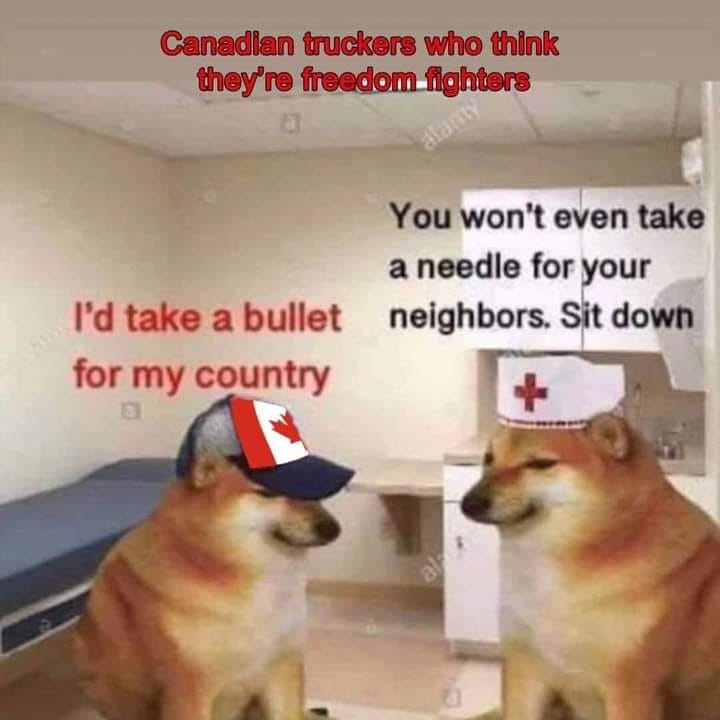
A typical meme shared by those against the FC
Let’s also not forget that many Canadians did not support the truckers. Many Canadians were calling the FC movement the “freedumb” movement. These Canadians were offended at the truckers for being anti-vaxxers. They were happy when Trudeau brought out the Emergencies Act. “Finally!” they said. Many of these folk believed the rhetoric put out by Trudeau accusing the FC of being racist. They watch the CBC and believe it. So, not only did Trudeau have the support of his fellow Liberal MPs, but he also had the support of a lot of Canadians (perhaps most). He does keep getting re-elected after all.
The truckers never had clear leadership. Who was going to negotiate? Who was going to decide a new strategy? Who was going to declare victory, or failure? Who was going to properly distribute the millions of dollars (or who will)?
More Yarvin…
[T]he trucker protest has two lessons. The first lesson is that any amount of informal anti-government action, regardless of its traditional practice or even apparent legality, and entirely regardless of the safety of pro-government action, is extremely unsafe and effectively illegal. If, after the action, the old regime is still around to prosecute or persecute you—it certainly will. This is the normal condition of human affairs, so try not to cry a new Mississippi about it.
The second lesson is that ultimately every action against a government is military, and every military action can be measured by a simple yardstick. The action succeeds not if it achieves its nominal mission, but if it alters the balance of power in its own favor. A step that makes you stronger and your enemies weaker is a victory. A step that makes you weaker and your enemies stronger is a defeat.
Not only is it easy to see that the trucker movement was smashed and the Canadian regime gained new, tasty emergency superpowers, as well as experience dealing with this surprising new tactic, there is an excellent yardstick for any informal action. The simple question is: did this action make it easier, or harder, to repeat the same action? If you cannot do the same thing you did last time, you must be weaker than last time. Maybe you gained somewhere else—maybe not.
Trudeau was morally wrong to use the Emergencies Act, but not politically mistaken. He had the power, he used it, and he won. He now has more power than he did before, and he has the truckers to thank for that. He acted against the heart of what Canada was founded to be, but Trudeau doesn’t care about that. He is the revolutionary in this story after all.
Are the truckers stronger now than before? Those who could go home have gone home. The rest? They are scattered. They have no money. They are forgotten by most Canadians….
Thus in one clear way the balance of power has changed in the regime’s favor—before the trucker protest, truckers could do something like the trucker protest. Now they can’t. They would just lose—so they will never even try. That’s how power works.
Yarvin
So, in the end I have to agree with Yarvin. The FC movement was not only a failure in that it did not achieve its goals, but it was also a worse failure in that it strengthened its enemy. Trudeau will carry on as per usual. His supporters, while maybe disagreeing with some of his recent actions, will respect him more because of the “strength” he’s shown. I put strength in quotation marks since I think he acted more in childishness than anything. He did play the political game well though.
Perhaps Trudeau will lose the next election to the Conservatives, but will the Conservatives do anything to prevent the government from abusing its power again? I doubt it.
This video, which seems to be MIA now, showed some truckers retrieving their trucks which were seized by the police. The trucks were not left in good condition, with windows being left open for lots of snow to get inside, for example.


 Pursuit of Percipience