Obviously, teaching children (pedagogy) is very different from teaching adults. Below are some notes on how to teach adults…
Adults are self-directed in their learning. Rather than passively listening to a lecture, adults like to be engaged in the class forcing them to take responsibility for their own learning. Adults like to discuss what’s being learned and provide their own input.
Adults have a lot of previous knowledge. They need to know how this new material will tie into what they already know.
For adults, the content must be relevant. Too much useless information will just make the adult student bored and the material will be forgotten. Adults need a reason to learn this new material. “How is this class going to help me get ahead?” is what the adult student asks. The course material must be relevant to the student’s life and work.
Adults are goal oriented and want to know early on in the course how we’re going to get “from here to there.” Even if the content relates to their life and work, pointless “bunny trails” will only distract and frustrate the adult student.
Adults are problem oriented and are attending the class to find answers to specific problems. If the teacher doesn’t have those answers, the adult student loses interest in, and respect for, the class.
The class needs to be fun, but not in a childish way. Activities also should be used to engage the student, but not insult their intelligence.
The teacher should strive to use visual (charts/diagrams/models), auditory (lecture), and kinaesthetic (hands-on activities) stimuli when teaching adults.
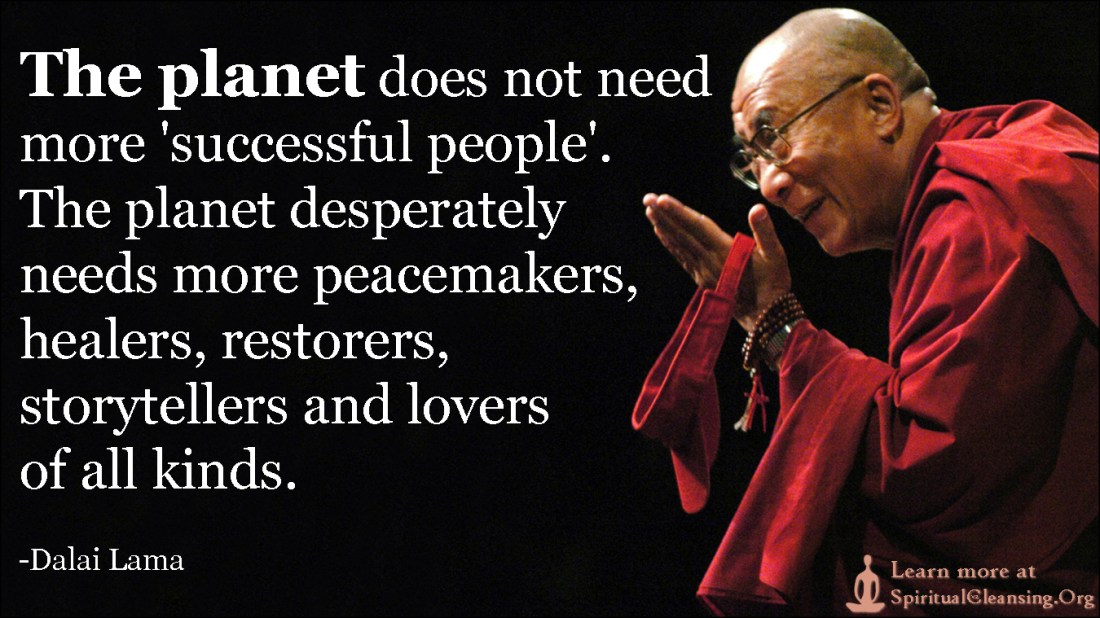
The picture above, and others like it, pop up on my social media every once and a while, and, although there is truth to it, it often leaves me scratching my head.
The people posting it are always well-to-do westerners who engage in the typical middle class life of working Monday to Friday, weekends of entertainment, and evenings of Games of Thrones watching. Also, these folks aren’t religious. They’re not atheist either. Rather, they are multiculturalists — which means all truth, cultures, and religions are equally valid. (A backdoor way of saying that nothing is valid.)
The Dalai Lama’s quote is very kind and inoffensive. Who would be against it? Only a hateful bigot. But… What does it mean? I always want to ask the person posting the quote a series of questions, which I know I’ll never get the answers to as it would cause too much uncomfortable thinking for them. So, I’ll just ask the questions here on my blog which no one reads just so that I can feel better and get on with my day.
To the person who posted the image….
Jesus said some nice things about peace and love too. So, if you would have posted the quote, “Greater love has no one than this: that he lay his life down for his friends,” and put a picture of Jesus beside it, I would assume that you were a Christian. So, can I assume that you are a Tibetan Buddhist?
Because, if you’re not a Tibetan Buddhist, we have a problem. The terms: ‘successful people,’ peacemakers, healers, restorers, storytellers, and lovers will only make sense in the context (for this particular quote) of who the Dalai Lama is. Love, for example, does not exist in a vacuum — there is always a subject and an object. If Jesus is the subject, then you can be sure that gay marriage is not the object. However, if the Dalai Lama is the subject, then gay marriage may very well be the object. So, are you a Tibetan Buddhist, a Christian, an Atheist? If you’re an atheist, the subject/object of love will change with each individual. But I already know that you’re a multiculturalist, so I can safely assume that the object of your love is anything that makes you feel warm and fuzzy — so we’ll just proceed from there.
Next question: Why is the term ‘successful people’ in quotation marks? Did the Dalai Lama speak this quote, or did he write it? If he spoke it, did he make the quotation sign with his fingers as he said ‘successful people’, or did the person who made the picture add the quotation marks as his or her own commentary? Assuming the Dalai Lama put in the quotation marks (which I doubt), how does he want us to define ‘successful people’? Rich people? But there are rich people who do a lot of good things for society, and there are a lot of evil rich people too, who drain society. Politicians? Are there no good politicians? Those quotation marks shroud the term in unnecessary mystery. What does it mean? But, you being the multiculturalist that you are, I think it’s safe to assume that, to you, ‘successful people’ refers to anyone richer and more powerful than you are.
Peacemaker — peace between who and who and who? Muslims and Jews? Muslims and Christians? North Koreans and South Koreans? Which group is going to abandon everything it believes in in order to conform to the other? As a multiculturalist, the answer to that question is: “Everyone will abandon what they believe and conform to multiculturalism.” Because, as a multiculturalist, that’s what your definition of peace is: if everyone would just admit that their beliefs are meaningless, and become multiculturalists, then we could all get along! Because, you believe that multiculturalism is the one and only truth, and since all truths are equally valid … wait … hold on … we’ve got a problem here. Jesus is called the Prince of Peace, because He reconciles humanity with God. But, we still must all conform to God — you know, the one who created us and owns us. That’s the only definition of peace that matters. (And it’s a good thing by the way.)
As for healing, I think the Dalai Lama is referring to more than just physical healing, he also means spiritual healing. So which religion will provide that spiritual healing? Is Nirvana the answer? Being born again with the Holy Spirit? Rational Atheism? Blowing yourself up and waking in paradise to find five hundred virgins at your disposal? Five hundred beautiful virgins! There’s a lot of men who’d like that one. Do we get to choose? We must if they’re all equally valid right?
Restorers. Restoring what? Storytellers. What stories?
I think that’s enough.
As for multiculturalism, I’ll just leave it to the great Mark Steyn to explain what it really means…
A question often asked about the Adam and Eve story is: Why did they fall? And why so quickly? If all was perfect and wonderful, why did they fall at all?
The answer usually given revolves around free will. God wanted them to truly love Him, and they couldn’t do that without free will. Okay, fine, they did have free will. But that doesn’t answer the question of why they chose to fall.
Free will is like gravity. Gravity is a powerful force in the universe, and it effects everything. But, when compared to other forces, gravity is relatively weak. Free will is like that – it is a force in your life, but it is weak compared to other forces in your life.
For example, take two men: one is an alcoholic who hasn’t had a drink in three days; the other has only tasted alcohol once and it nearly made him puke – he hates it. Lock both men in a room containing only a full bottle of whiskey. Both men have free will – they can both choose to drink or not to drink, but we all know which man will drink. One man is predisposed to drink while the other is not. The force predisposing the man to drink is stronger than his free will. That doesn’t mean he can’t choose not to drink; it just means he probably will choose to drink. That’s an imperfect example of course, but it helps us to understand why Adam and Eve chose to disobey God and eat of the Tree of the Knowledge of Good and Evil.
What was the Tree of Knowledge? Read 1 Kings 3:6-9:
“And Solomon said: ‘You have shown great mercy to Your servant David my father, because he walked before You in truth, in righteousness, and in uprightness of heart with You; You have continued this great kindness for him, and You have given him a son to sit on his throne, as it is this day. Now, O Lord my God, You have made Your servant king instead of my father David, but I am a little child; I do not know how to go out or come in. And Your servant is in the midst of Your people whom You have chosen, a great people, too numerous to be numbered or counted. Therefore give to Your servant an understanding heart to judge Your people, that I may discern between good and evil. For who is able to judge this great people of Yours?'”
Also read 2 Samuel 14:17; Deuteronomy 1:39; Hebrews 5:12-14. All these passages show us that a knowledge of good and evil (the ability to discern and judge between good and evil) is a sign of maturity and kingly rule.
Just as the alcoholic is predisposed to choose to drink, Adam and Eve were predisposed to choose to rule. It was not a bad thing for them to want to do this, God created them that way (Genesis 1:26). But, to rule requires wisdom – an ability to discern good from evil. Adam and Eve, at the beginning, were like little children and not ready to to rule fully (Deut. 1:39). God did start them on the path of rule in the confines of the garden, but they had to mature to a point where they could rule outside of the garden.
Enter the serpent. Who was this serpent? I believe it was simply Satan in his naturally created form. Not all angels look alike, it would seem, and not all angels resemble men. The Cherubim and Seraphim are mighty dragon-like angels (Seraphim means “fiery serpent” in Hebrew). Satan himself is called a dragon in the book of Revelation. And why was the serpent there? Well perhaps the serpent, not yet fallen himself, was sent to Adam and Eve to be a tutor, a teacher, to show them how to rule. This would mean that Adam, Eve, and Satan all fell into sin at the same time. There’s no biblical reason to believe that Satan and the angels existed for millions of years before the creation (if there was such a thing as “years” before the creation), and that at some point in that “before-time” Satan fell.
God told Adam and Eve to increase and multiply and to fill the whole earth. Perhaps they needed a tutor who was a crafty beast from the field/wilderness (outside of the garden) to teach them what the rest of the world was like. We don’t know how long the serpent spoke to Eve, but at some point in the conversation, I believe, Satan realized what God had planned for mankind (to rule) and he became jealous.
Satan did not fall because he wanted to be like God, he fell because he wanted to be like Adam. Adam fell because he wanted to be like God too quickly.
Notice that the worst of the punishments fell on the serpent (Gen. 3:14-19), which means that he was the most responsible for the fall. It also means that he was not in the same category as Adam and Eve. God promised salvation to Adam and Eve (Gen. 3:15b), but not to the serpent.
The serpent understood that to cause Adam and Eve to fall he would need to tempt them to enter into their rule prematurely. The Tree of Knowledge was off limits to Adam and Eve, but not permanently. They would, over time, mature into the ability to eat of it. But the serpent knew that they were predisposed to rule and that that force could be used to overcome their free will to simply obey God. And he was right.
Jesus was also tempted by Satan (Matthew 4:1-11) – and in the same way as Adam and Eve, although no longer in the safety of the garden but in the wilderness itself.
Jesus came to rule (Isaiah 9:6-7), and Satan offered Him a short cut. Jesus truly was tempted to give in to Satan. He desired what Satan was offering. Jesus was, too, predisposed to rule. But, being the first mature man, He did not give in and chose to obey God first. Jesus, being the second Adam (1 Corinthians 15:45-49), obeyed God and made the way for all of us to be restored to our true purpose: to rule.
Adam and Eve’s great mistake then was not a desire to know good and evil, or a desire to be like God (those are good things), but rather, their great mistake was not trusting God and not obeying Him. Our predispositions may be stronger than our will, but our obedience to God must be stronger than all.
“If you love Me, you will keep My commandments.” ~John 14:15
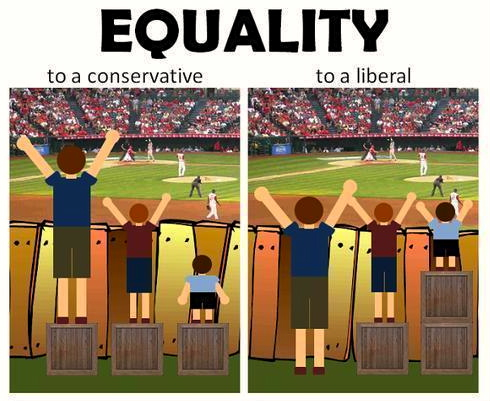
Sometimes we can use simple illustrations to explain more complex ideas. That is fine if the illustration is in fact used to explain the more complex idea. Often that’s not what happens – often we’re just shown the illustration, and because it’s simple, we think we understand the more complex situation automatically.
Take the picture above: On the left, they all have a box, but still the short guy can’t see. So, on the right, the tall guy gives him his box and all is well. That’s justice, see? Simple.
Well, if I were at a game watching over the fence and some guy needed my box to stand on, and I didn’t need it myself, of course I would give mine to him – I’m not a complete jerk. But of course, a baseball game is not what’s really the issue here. We’re talking about wealth, poverty, and social politics – much more complex issues.
How can we translate the simple illustration to the real complex problem?
We ask what each item in the illustration represents.
What do the boxes represent? Money? Power? Knowledge? All three? Something else? Why are there only three boxes? They can’t get more? Why do they all start off with one box each? Why is one guy taller than the other? Do these guys always stay the same height over the course of their lives? How is time illustrated in this picture, if at all?
What does the fence represent? Why is it the height it is? Is it shorter in other places where the short guy could see over with only one box? Why are all three guys standing right next to each other? In the real world, does the tall guy even know the short guy exists? Could the tall guy simple pass his box over to the short guy without someone else getting involved? What if the tall guy doesn’t want to give up his box? What if he’s going to need it to look over a taller section of fence further down?
What does the baseball game represent? Happiness? A house, car, and a flatscreen TV? Or just basic living needs? Who determines what poverty is? What’s being compared to what? Is the standard of living the same for all three guys? Is it essential to watch the game at all? Why don’t they buy tickets and watch inside?
These are just starter questions. As they’re answered more questions will come.
So, try answering all these questions and you’ll see that the situation is much more complicated than what the picture suggests.
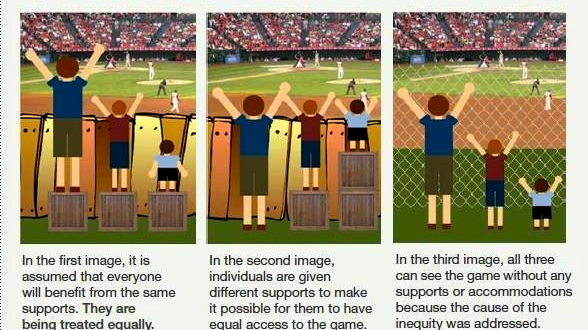
Here’s a couple of other versions of the picture I found online…
In light of all the “safe space” talk coming out of universities these days, I thought I’d quote Eugen Rosenstock-Huessy speaking to his students in a philosophy course at Dartmouth College in the 1950s….
“So my appeal in all these (philosophy) classes, you may now understand, has always been to you as people who have to outgrow your childishness. I therefore cannot act as your wet-nurse. I — I’m not interested when you have a cold. Have 10 colds. Suffer! Because it will make you able, if you really suffer, to grow up. And if you — (if) I should pity you in all your difficulties and hardships, you see, I would forestall this process. I would tell you that you are still protected. I am not here to protect you against anything. I’m here to expose you. And this is what the world can expect from anybody who has this tremendous retardation of his growth granted to him in a college.”
*Quote taken from lecture #15 of Cross of Reality taught at Dartmouth College in 1953.
Rosenstock-Huessy’s lectures are available for free mp3 download here.


 A question often asked about the Adam and Eve story is: Why did they fall? And why so quickly? If all was perfect and wonderful, why did they fall at all?

 Pursuit of Percipience