

 Other Kinds of Relationships
“Friendship is unnecessary, like philosophy, like art… It has no survival value; rather it is one of those things that give value to survival.”
~C.S. Lewis
There are other types of working relationships besides covenants and contracts. Each of these different kinds of relationships may have certain aspects of covenants or contracts, but they are wholly different. The four main types of working relationships that I can think of are:
1. Friendships
- These relationships consist of one or more people who have common interests. The parties aren’t looking at each other (like lovers), but rather are standing side by side looking forward (see C.S. Lewis’s The Four Loves).
- The duties of the parties in a friendship will include covenant-like expectations, but there is no ritual or ceremony formalizing these expectations. They are implicit.
- Friendships might last a life time, or not. The duration of the friendship is never discussed. Friendships will end when the commonality between the parties fades away. This might happen when one party has a major worldview change (like becoming religious), when one party matures faster than the other(s), or it might simply happen when one party moves to a new physical location.
2. Charity
- One party is in need, and another fills that need.
- Like in a contract, one party needs the other’s resources.
- Like in a covenant, one party cannot “pay back” the other.
- The lifespan of this relationship can last a long time or a short time — it depends on the giver’s generosity and the receiver’s need.
- There are no expectations in charity, except that the giver may want his gift to be used for a specific thing. That specific thing must be determined by the receiver — if it is determined by the giver, it is no longer charity, but a contract. If the receiver does not meet the giver’s expectations, the giver does not get his gift back.
3. Master/Slave
- The slave simply must do what the master requires as his life depends on it.
- The master must only care for the slave as long as he wants the slave to be an effective and hard worker.
- The relationship will last as long as the master wants it to, or until one party dies. The slave cannot determine the length of the relationship unless the master introduces some contractual conditions.
- There is nothing covenantal in the master/slave relationship. As soon as this relationship takes on covenantal properties, it ceases to be a master/slave relationship.
4. Neighbours
- This relationship is based solely on the physical proximity of the parities and will only last as long as the parties are near each other (living side by side, driving side by side, waiting in line side by side, etc…).
- There are certain implicit rules, depending on culture, which both parties will be expected to follow. These rules will (should) be common sense and common knowledge.
There is also a non-working relationship: Acquaintanceship. Acquaintances know each other, but they are not friends, and there is no expectations in that relationship at all, other than basic politeness and neighbourliness when required.
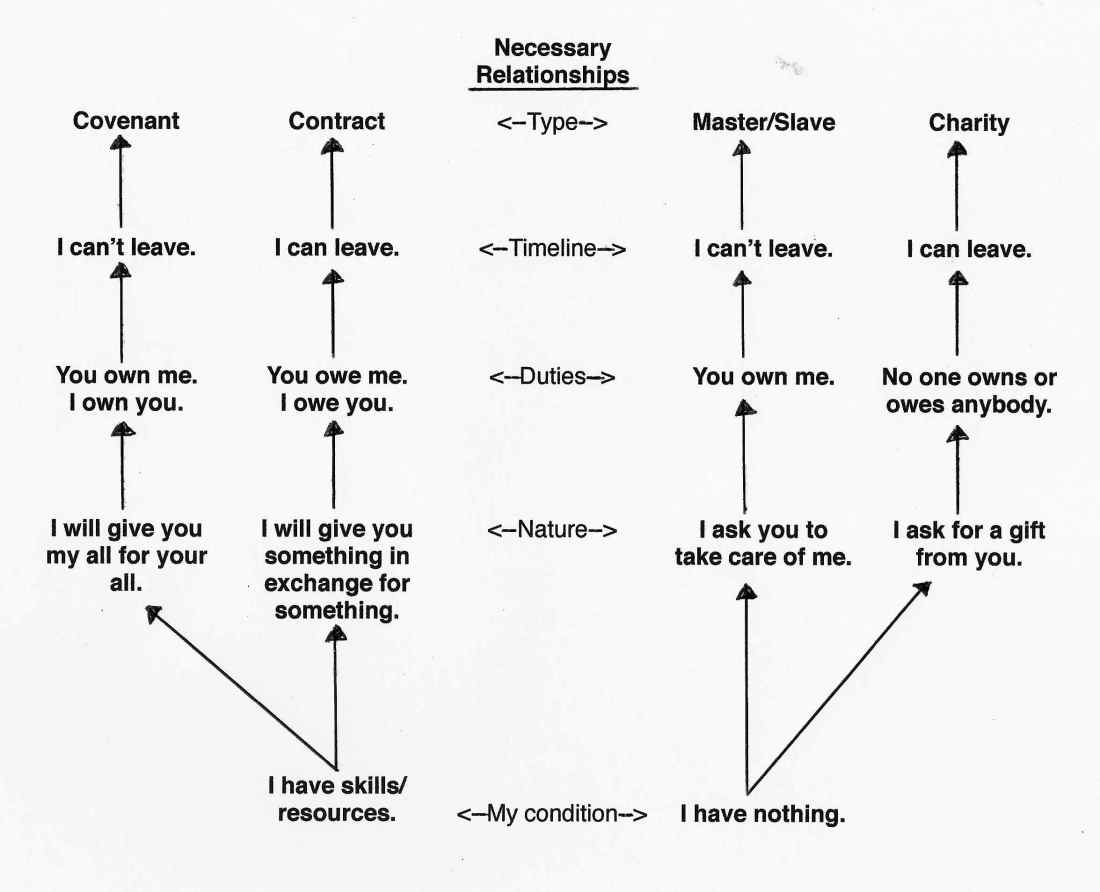
The diagram above shows what I believe are the four necessary relationships. You simply cannot function in this world unless you are in one or more types of these relationships.
The three types of relationships I would consider to be unnecessary (you can survive without them) would be friends, neighbours, and acquaintances. Acquaintances would be, I think, the most shallow of these three.
And then of course there are all the familial relationships: parents, brothers/sisters, cousins, aunts/uncles, etc…. However, I think many of these relationships can fit into one of the three unnecessary relationships. How many of your cousins are merely acquaintances? If you’re like me, most are. Brothers and sisters would often fall into a covenantal relationship — even if those relationships are off and on over the years. The parent/child relationship is of course unique. A child is not a fully developed person, and so, cannot know how to decide to act in any relationship, other than what he is taught. A parent/child relationship is not charity. Any parent who would consider taking care of their own child an act of charity is simply a bad parent.
I suppose two other kinds of relationships we could mention are teacher/student and colleagues. But again, we can fit those into previously mentioned types of relationships — teacher/student is a contract, and colleagues can easily fit into neighbour or acquaintance in relation to each other, combined with contract in relation to a common employer. If one is training and teaching a colleague, that is a contract — not between the colleagues, but between the employer and the trainer.
 Covenant Vs. Contract
 Staying Loyal

 If you live in the west and travel to the east, you have to be careful with the electrical devices you bring.
