
Recently I listened to a conference speech online. Well, I listened to half of it. It was too boring to finish. The topic was trustworthiness. One of the points made over and over was that if you say you’re going to do something then you should actually do it. Wow! What an epiphany!
I thought, “Is this speech being give to a bunch of twelve year olds?” But no, it was being given to adults. And I thought more, “Do the people in the audience feel as though their intelligence is being insulted? They should.” The whole speech was delivered as though it was either being given to stupid adults or to inexperienced kids.
I’m usually not a fan of conferences. I don’t want to be mistaken as an ungrateful complainer though. I appreciate the amount of work that goes into organizing a conference, and I would never suggest that the organizers’ hard efforts are a waste of time (well, maybe I would). I also know that a lot of people really love conferences and truly benefit from them, and, not everyone thinks like me. In fact, I am in the minority it would seem. I understand the perceived importance of conferences. I understand people want to get together once and awhile, people who ordinarily don’t see each other, and remind themselves why they’re doing what they’re doing and why they need to help each other. I’ve met some great peo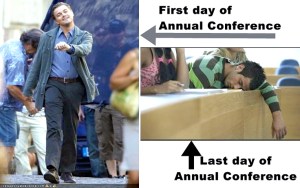 ple at conferences; people who I continued to work with for years afterward. I understand the leadership wants conferences to set the direction for the organization, and motivate the people, and cast vision and all that stuff.
However, I’m still not a fan. There are few things more boring and pointless than sitting in a chair for three hours listening to a speech you’ve heard a hundred times already. I don’t need to listen to a lecture given by someone who has no experience in what I’m doing. I certainly don’t want to spend three or more days at a conference, away from my work and home, lying every time someone asks me about how great the conference is, pseudo-enthusiastically yelling “Hallelujah!” every time a speaker does so, and then walk away from the whole thing feeling emptier than when I showed up.
When I think of conferences I’m often reminded of a scene from the film Waterworld. The earth is covered with water, but there’s a little girl with a tattoo on her back with instructions to find dry land. Problem is, no one can read the instructions. The bad guys, called “Smokers”, capture the girl. The Smokers live on a big oil tanker and how they get it around is by rowing — hundreds of men sticking long oars out the sides and rowing, just like with the old wooden ships. The leader of the Smokers gives an inspiring speech, holding up the girl in front of everyone, proclaiming that they will find the land and create a great future, etc… After the speech the rowers are so hyped that they get to work immediately and exuberantly. Meanwhile, the leader, still not knowing how to read the instructions, in private with his closest advisors is asked, “So which way we rowin’?” and he replies, “I don’t have a g–d–n clue. Don’t worry, they’ll row for a month before they figure out I’m fakin’ it.”
I’m not suggesting that leaders in conferences are “fakin’ it”. But, I’ve lost count of how many times I’ve come out of a conference hearing attendees proclaiming all the great things they’re going to do after being so encouraged by the conference speakers, and then never doing anything. I remember driving home from a three day Christian men’s conference, my intelligence freshly insulted, and my passenger, a railroad worker, declared, “I’m going to plant a church when I get home!” And I just smiled and thought, “No, you’re not.” Because anyone making a major decision like that, in an emotionally charged atmosphere such as a conference, is never thinking straight. And he never did plant that church.
The more honest attendees will be more level-headed, or even discouraged. I’ve known several people, who were already doing some kind of ministry, come out of a Christian conference feeling small and unimportant. I’ve heard laments like, “My ministry is hard work, and I wish I would have been able to meet people at the conference who were going through the same struggles I am, so that I could have talked with them and gotten to know them. But there was no time for that. Instead we just listened to grand speeches which included things like the leader yelling, ‘This is just the beginning!!’ over and over. What’s the point in that?”
My last article, Andragogy (Adult Learning), points out how adults, when attending a class or a conference, are not interested in generalities. They want specific teaching which directly relates to what they’re doing in life. They also don’t want to just sit and listen to a lecturer without having their own life experience and knowledge taken into account. What adult wants to sit and listen to a lecture that would better be delivered to a group of twelve year olds? Adults need to engage and speak and share. I know from personal experience that I would much rather sit in a small group setting, where everyone can participate, than sit in a large conference setting where you just, well, sit.

 A question often asked about the Adam and Eve story is: Why did they fall? And why so quickly? If all was perfect and wonderful, why did they fall at all?