The Day the Revolution Began (Book Review) Part One

Revolution

You could rename this book Christianity 101. If I were to recommend just two books by N.T. Wright, they would be Simply Good News, and this one, The Day the Revolution Began.

N.T. Wright’s main push in a lot of his books is that the traditional definition of Christianity (Jesus died for your sins so that you don’t have to go to hell) is only one slice of a much larger pie, and the problem of Western Christianity is that it made that slice the whole pie.

The Reformation really centred on one main issue: How does the individual get saved? It was necessary to focus on that issue at that time as the Catholic Church had really messed it up. But, over the last 500 years, the Church has never gotten away from focusing on that one issue. N.T. Wright criticizes that problem. The early Christians didn’t focus on that issue, and neither did the pre-Christian Jews.

This is how many, if not most, Christians view their faith:

“God told his human creatures to keep a moral code; their continuing life in the Garden of Eden depended on their keeping that code perfectly. Failure would incur the punishment of death… Humans were therefore heading for hell rather than heaven. Finally, however, Jesus obeyed this moral law perfectly and in his death paid the penalty on behalf of the rest of the human race… Those who avail themselves of this achievement by believing in him and so benefiting from his accomplishment go to heaven… those who don’t, don’t.” (Page 75)

Wright does not deny the truth of that description of Christianity; he just argues that there is much more to the faith that only that. Wright says our biggest problem as humans is not that we are sinners who broke some law, but rather that we are idolators. “The human problem is not so much ‘sin’ seen as the breaking of moral codes–though that, to be sure, is a part of it…– but rather idolatry and the distortion of genuine humanness it produces.” (Page 74)

The result of putting anything before God, refusing to worship Him, and refusing to live out our created purpose leads to sin, and sin leads to death, which is separation from God. The Israelites of the Old Testament saw their exile as a form of death. It was when Israel stopped worshipping God and refused to fulfill their role as a kingdom of priests to the nations that God desolated the temple and sent His people into exile.

For Israel, the term “forgiveness of sins” was directly related to being allowed to return from exile. Wright argues that we too need to see that term in the same light as the Jews. Exile for humanity is the being cut off from proper human life: peace, unity, love, being proper image bearers and worshippers of God.

“[L]awbreaking is a symptom of a much more serious disease… [idolatry]… The result is slavery and finally death. It isn’t that humans do wrong things and so incur punishment. This is one element of the larger problem, which isn’t so much about a punishment that might seem almost arbitrary, perhaps even draconian; it is, rather, about direct consequences.” (Page 77)

N.T. Wright suggests “that in the Bible humans are created in order to live as worshipping stewards within God’s heaven-and-earth reality, rather than as beings who, by moral perfection, qualify to leave ‘earth’ and go to ‘heaven’ instead.” (Page 77-78)

Wright uses the term vocational covenant. Our vocation as humans is to image God to creation as caring stewards, and to image creation back to God as thankful worshippers. If we abandon that vocation we corrupt ourselves and creation too. Sin is simply the result of breaking that vocational covenant, which then leads to death and separation from God.

So, notice how Wright’s emphasis is not You broke God’s law and now He’s angry at you and you are going to hell, but rather it’s, We abandoned our vocational covenant by refusing to worship God and refusing to steward creation, and because of that we have corrupted ourselves and are separated from God.

The question then is: How is this problem of us breaking our vocational covenant, and the consequences thereof, fixed?

Wright spends some time writing about the purpose of the nation of Israel. As I mentioned above, Israel was a kingdom of priests to the nations. That means that they were acting as the image bearing mediators between God and the world. They were priests, and as priests they were to work to reconcile creation with God. That of course included being a light to the Gentile nations. This was, as Wright puts it, their vocation.

You have seen what I did to the Egyptians, and how I bore you on eagles’ wings and brought you to Myself. Now therefore, if you will indeed obey My voice and keep My covenant, then you shall be a special treasure to Me above all people; for all the earth is Mine. And you shall be to Me a kingdom of priests and a holy nation.
~Exodus 19:4-6

It is too small a thing that You should be My Servant
To raise up the tribes of Jacob,
And to restore the preserved ones of Israel;
I will also give You as a light to the Gentiles,
That You should be My salvation to the ends of the earth….
Kings shall see and arise,
Princes also shall worship,
Because of the Lord who is faithful,
The Holy One of Israel;
And He has chosen You.
~Isaiah 49:6-7

Arise, shine;
For your light has come!
And the glory of the Lord is risen upon you.
For behold, the darkness shall cover the earth,
And deep darkness the people;
But the Lord will arise over you,
And His glory will be seen upon you.
The Gentiles shall come to your light,
And kings to the brightness of your rising.
~Isaiah 60:1-3

When Israel was faithful to that vocation they were at peace with the nations and the nations would come to them to worship God. But, when they abandoned that covenant, they would be in conflict with God, and thus the nations as well. Continual non-repentance led to exile, when the Israelite people were pushed out of their promised land, their temple was abandoned by God, and they spent a time in “death” separated from the true life that they were supposed to have.

“[H]umans were made for a purpose [and] Israel was made for a purpose, and … humans and Israel alike have turned aside from that purpose, distorted the vision, and abused their vocation.” (Page 99)

The Greek word for sin, hamartia, means “missing the mark”. Wright points out that sin then is not so much a result of failing to keep a “do/don’t do” list of rules, but rather failing to be proper image bearers, and failing “to reflect the praises of creation back to the Creator and [failing] to reflect the Creator’s wise and loving stewardship into the world.” (Page 99)

If Israel was supposed to reconcile the creation back to the Creator, what would happen if Israel itself was in need of reconciliation? How could they fulfill their vocation if they themselves were just as corrupt as those they were called to help? What could be done if those who had the authority to reconcile had forfeited that authority over to powers which worked for evil and death? Others, or One, would have to come and take back that authority and fulfill the vocation of reconciliation.

When the tabernacle was first complete, the glorious presence of God came down to cover it (Exodus 40:34ff), and again when Solomon’s temple was complete, the glory cloud of God came again (1 Kings 8:10-11). However, after the exile, when the Jews went back to Jerusalem and completed the rebuilding of the temple, there is no mention of God’s glory coming down then (Ezra 6:13ff). What you do see is the presence of God leaving the temple (what would have been Solomon’s temple) in Ezekiel 10 & 11.

In Malachi, a prophet sent to Israel after Ezra’s temple had been built (the second temple), we see that the Jews were neglecting their covenantal responsibilities again. They were doing so because they were disappointed at what the second temple era was: no renewed kingdom of Israel (they were still in a form of exile) and a perception that God’s glory never did return from exile with them to once again fill the temple. But Malachi told the people: “Behold, I send My messenger, and he will prepare the way before Me. And the Lord, whom you seek, will suddenly come to His temple, even the Messenger of the covenant, in whom you delight. Behold, He is coming.” (Malachi 3:1) Now, that messenger sent to prepare the way was John the Baptist (Matthew 11:10; Mark 1:2; Luke 7:27), so, “the Lord who will suddenly come to His temple” was Jesus.

“In Jesus’s day, the hope was alive that the Glory would return at last. But nobody knew exactly what that would mean, how it would happen, or what it would look like.” (Page 112) The Jews’ great hope after the exile was not to make it to heaven when they died, but to be restored within the present world, to be forgiven of their sins, and to be a part of the new covenant promised to them by the prophet Jeremiah (Jeremiah 31:31-34). This new covenant, we know today, would also include the Gentile nations.

Jesus is the One who took the vocational covenant of Israel onto Himself and fulfilled it once and for all in His life, death, and resurrection. But how does that work? What did Jesus really do on the cross?

To be continued in Part Two…..

Further reading….

N. T. Wright: The Church Continues the Revolution Jesus Started

N. T. Wright Reconsiders the Meaning of Jesus’s Death

Seven Revolutions (Book Review)

7 revs

Seven Revolutions: How Christianity Changed the World and Can Change it Again was written by Mike Aquilina and James L. Papandrea.

It teaches an idea which I strongly agree with: that Christianity, since its beginnings, has changed the whole world for the better and continues to do so.

The authors focus on seven revolutions; seven ways in which Christianity rearranged the world in new and positive methods.

The first revolution is concerned with Human Dignity. Unwanted life, be it children, or slaves, or cripples, was thrown away in the ancient world, and no one thought much of it. It was the first Christians who condemned this behaviour and openly spoke out against abortion, child murder, gladiatorial violence, and the overall low view of “inconvenient” persons.

The second revolution, which builds on the first, is on Family. In contrast to the Roman culture, Christian homes had husbands and wives who loved each other, and children who were valued and cared for. The marriage was not just a contract, and the wife was not just the property of the husband (she was, but he was her property now too). Sex was seen in a new light as well: not just something for the physical pleasure of the man, but a sacred activity to both marriage partners. As one second century author wrote:

“They [Christians] marry, as everyone does; they beget children, but they do not destroy their offspring. They have a common table, but not a common bed. They are in the flesh, but they do not live after the flesh. They pass their days on earth, but they are citizens of heaven. They obey the prescribed laws, and at the same time surpass the laws by their lives. They love all men, and are persecuted by all.” (Epistle to Diognetus, 5)

The third revolution addressed is that of Work, and how labour became holy. “Shoemakers, cleaners, weavers — these were the people who called themselves Christians. How could a religion made up of such lowly people be anything but contemptible?” (Page 80) Manual labour was despicable to the upper classes in the ancient world, and that type of work was best left to slaves. But Christians welcomed and treated as equal both manual labourers and slaves in relation to the upper class Christians. Manual labour is seen as holy in the Christian faith. God Himself worked with His hands in creating the world. How could a religion like this lead people to salvation when clearly the physical world is dirty and disgusting while the spiritual world is beautiful and pure?

The fourth was a revolution of Religion. Whereas the pagan religions of the past were more so contracts between patron (the god) and people and were seen as a patriotic duty, Christianity focuses on having an actual relationship with God and with fellow believers. A Christian, rather than trying to guess at what makes the gods happy, receives divine revelation which allows for a direct and intimate knowledge of God. And then there is the monotheistic/trinitarian nature of God: God is one, but He is three persons in relationship, and that relationship of love spills over into humanity causing Christians to not only love God, but also to love people. And don’t leave out the Christian view of morality — living a life which pleases God, not to earn salvation, but to live out the salvation already received.

Number five: a revolution of Community. The authors, perhaps unnecessarily, start this chapter with an overview of the Augustine/Pelagius controversy. Augustine believed in original sin and total depravity, while Pelagius believed in free will and humanity’s ability to live a perfect life. The Church (the Catholic Church) decided the truth was somewhere down the middle of those extremes — not all depends on God, and not all depends on us. Therefore we must work with God in His mission to “extend His love to others.” (page 137) The debate of free will vs. original sin still rages on in Protestant circles, but the point of the book is clear: “the revolution of the community is that God calls us to love our neighbour.” (Page 137) The focus here is on working with the poor, and the contrast of Christian charity (loving others for the sake of love) against pagan charity (doing good to others to be seen doing good). Christians are not to build up treasure in this world, but rather in heaven, and “the storehouses of heaven are the stomachs of the hungry.” (Page 141)

Next, a revolution in Death. This is a Catholic book, and while I don’t think it’s too Catholic for non-Catholic readers, this chapter on death does hold much of the theology, particularly concerning relics and patron saints. While I’m not Catholic myself, I do agree with the premise of this chapter, which has to do with resurrection and Christianity’s conquering of death itself. Death has no more sting and the horrors of death are nothing more than a temporary sadness. A new body and a new life await those who belong to Christ.

The final and seventh revolution is about the State and Religious Freedom. Again, being a  Catholic book, there is no mention of the Reformation’s contribution to the western world and to how individual liberty grew out of that movement influencing so much of western politics. The book mainly focuses on the influence of Constantine and his edict of religious tolerance. “By the time the Church was in a position to influence government in the fourth century, a Christian idea of government had emerged — that those who governed should be the protectors of those whom they govern. Leadership was not a right; it was a responsibility — one that included serving the ‘least’ of society. To govern was to be entrusted with something very valuable — human beings created in the image of God and the resources to sustain them. In other words, Christian leadership is a form of stewardship” (page 183). That’s good in theory, but fast forward 1000 years and the Church’s rule wasn’t doing so great. Much was corrected by the Reformation.

The final two chapters talk about how the Church can change the world again. Several “to-do” items are given for the Church:

  • Reject isolationism
  • Respect the value of every human life
  • Reject the culture of celebrity and humiliation as entertainment
  • Respect the humble, the labourer, and the poor
  • Reject the creation of a secular religion of the state
  • Respect religious freedom (freedom of religion, not from religion)
  • Reject a defeatist attitude
  • Respect your neighbours

All in all I thought it was a good book. I give it 3.5 out of five stars. I think the Catholic authors focused too much on ancient history, neglecting the huge changes made in the last 500 years. But, there is much to be learned from those ancient centuries as well so that we need not repeat the mistakes of the past.

“The seven revolutions of the Church can be broadly grouped into two categories: the protection of all human life, and the protection of each person’s dignity and freedom.” (Page 204)

“Just like the early Christians, we may find ourselves facing a choice between two kinds of sacrifice. We will either sacrifice our place of comfort within society to speak up for life and freedom, or we will sacrifice our convictions and accept the current definition of freedom (that is, absolute freedom of convenience for the individual, and freedom from having to be confronted with expressions of religious faith that may convict one of selfishness).” (Page 217)

***

A Storm of Swords (Brief Book Review)

A Storm of Swords (A Song of Ice and Fire, #3)A Storm of Swords by George R.R. Martin

I just finished the third book of George R.R. Martin’s A Song of Ice and Fire Series.

This series is, as everyone knows, the storyline behind the Game of Thrones TV series. Not long ago, and before I read the first novel, I bought the first season of the show on DVD. I watched the first episode and liked it. The problem for me though was all of the explicit sex and nudity. I’ve got three little kids at home and I don’t want them seeing any of that stuff. Plus, me being a married man, I thought it best if I didn’t watch it either. I returned the DVDs. However, later on, I did end up binge watching all six seasons of the TV series online. Despite the unnecessary sex and nudity, the show is excellent.

The novels and the TV series tell a story which I believe is very relevant to our world today. Martin obviously bases his world on the real one, and does a good job illustrating the conflicts we see today; for example: the true threat against Westeros is coming towards the ill defended wall, but the kings and lords are apathetic to the danger as they fight one another to establish their own power. The one question I found myself repeatedly asking while watching and reading is: Where is the righteous king who will come and set everything right?

There are two more published novels after this third one (A Feast for Crows and A Dance with Dragons) and there are apparently two more in the works. Also, it’s said there will be another two seasons of the TV series. I don’t know if I’ll bother watching the new TV seasons coming as I am into the novels now. I do hope the author actually finishes the series.

The novels run at about 1000 pages, but it’s still effortless reading.

Just to illustrate how good the TV show is, here is a clip from season six, episode ten (spoilers of course)…..

https://www.youtube.com/watch?v=hjtPtTUx_ks

My rating of A Storm of Swords: 5 of 5 stars

View all my reviews

Explaining Postmodernism (Book Review)

ep Explaining Postmodernism: Skepticism and Socialism from Rousseau to Foucault by Steven R.C. Hicks (which is available for free here) is a well written and fairly easy to understand critique against the train wreck that is postmodernism.
I am not completely finished this book as I want to read through the philosophical sections slowly so that I can pick up everything. For me, this is not a book that can be read quickly as there is lots of new information that I don’t want to overlook.

Hicks blames Immanuel Kant for getting the whole thing started with his theory of perception. Kant opposed objectivism and reason because we people can never know reality apart from the mediator of our senses. The chair is red because the light reflects off of the chair and some colours are absorbed while others reflect into your eye which converts the info into electrical impulses and sends them to your brain and hopefully nothing goes wrong along the way. But is the chair really red? Really? Who knows? You certainly don’t, because according to Kant, you only live in your head. “The key point about Kant, to draw the analogy crudely, is that he prohibits knowledge of anything outside our skulls” (Hicks, pg. 41)

“Once reason is in principle severed from reality, one then enters a different philosophical universe all together.” (Hicks, pg. 41) There can not be absolute truth if reality exists apart from one’s perception of reality. I cannot declare that there are only two genders if that claim is solely based on my subjective perception of reality. If that claim is true it has to be objectively true regardless of my observation, or even my existence.

I agree that Kant went to far in limiting us to “our skulls,” but I would argue that we are indeed limited to the physical universe — our senses may show us what’s real objectively, but only within the universe we have access to. Kant criticized objectivity in defence of God. We can see what we see because God gave us the senses to see it, but that does not mean we are seeing things as they really are, but rather, only as how our God given senses allow for. We can take that too far and limit ourselves only to our heads, but we can also take objectivity too far when we deny that things exist beyond our ability to sense them. We can’t prove that God exists with the scientific method, but that doesn’t mean God does not exist. Postmodernists hold to the “limited to the skull” theory, not to defend God, but to attack any and all truth claims. But, as Hicks argues in the book, it is impossible to live in a world where nothing is objectively true.

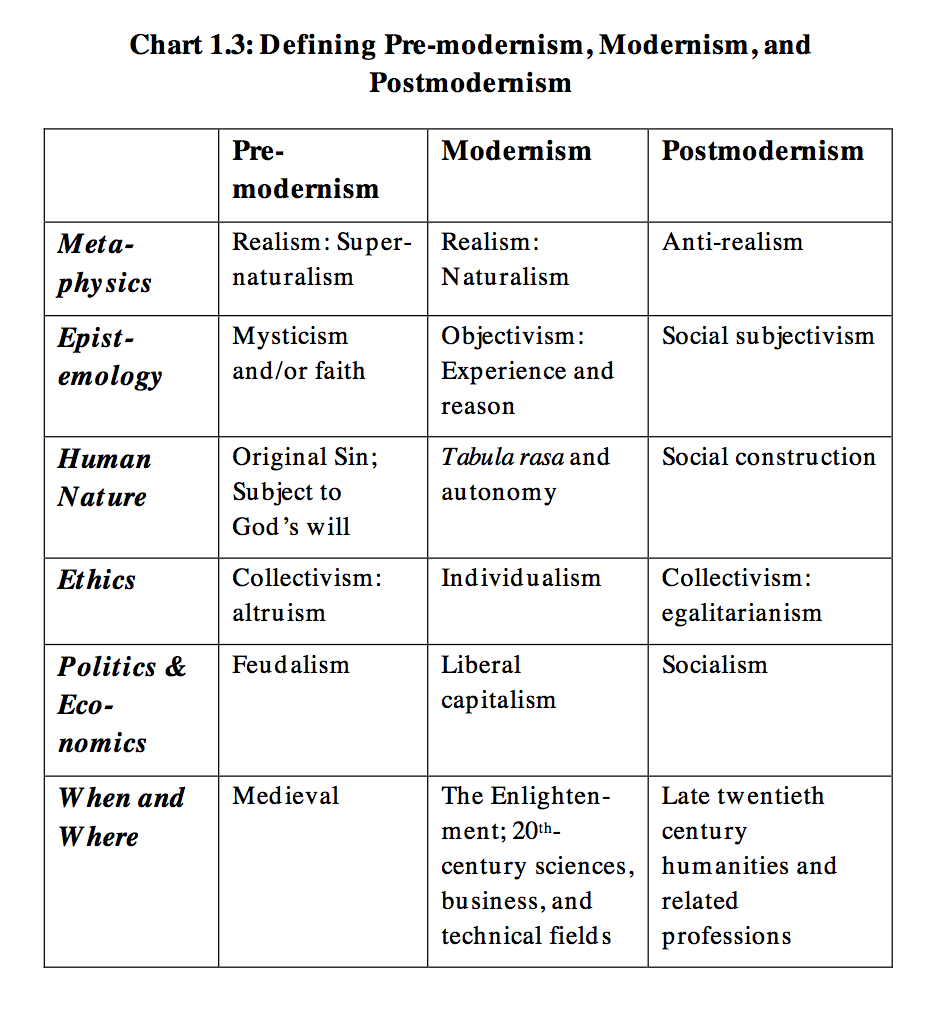
After the first chapter, Hicks goes deeper into the philosophical background which produced postmodern thought. If you are not interested in all that, then I recommend reading at least the first chapter of this book. In it, Hicks gives a good overview of what postmodernism is as compared to modernism and pre-modernism (briefly illustrated in this chart, from pg. 15)….

chart 001

So far, it’s a good book. And as I say, if you’re not interested in all the philosophy, at least read the first chapter. Perhaps when I’m finished reading the whole book I’ll update this review.


Letters to the Third Millennium (Book Review)

Letters to the Third Millennium: An Experiment In East West CommunicationLetters to the Third Millennium: An Experiment In East West Communication by Clinton C. Gardner

My rating: 4 of 5 stars

If you’re into Eugen Rosenstock-Huessy you’ll like this one. This book goes well with ERH’s Out of Revolution and certain sections of his I Am an Impure Thinker.*

Gardner focuses much on ERH’s ideas of The Four Phases of Speech and The Cross of Reality.

The Four Phases of Speech

4 phase

When I read literature from the past, I am not just reading it in a detached analytical way. Take the book of Isaiah for example. When I read it, I am there with Isaiah when he says, “Here am I! Send me.” I am there when Isaiah carries out his calling, preaching to and warning the people of Israel. I am there when Isaiah completes his task and is able to say, “Lord, for better or for worse, we have completed our task and have spoken to the people.” And I am there to see Israel dragged off into captivity into Assyria because they did not heed the words of the prophet, and I can stand back and analyze that result. I am connected and in relationship with Isaiah and Israel. I am the last part of the story.

“Human speech never was intended for expressing platitudes like ‘the weather is bad,’ or ‘come,’ or ‘I am happy,’ or ‘the moon rises.’ Human speech corresponds to the construction of our brain so as to permit the transfer of acquired experiences to the race. Speech enables us to gain times and spaces for ‘settling’ a question. Speech connects the departments of experience. The event which is expressed can only be expressed in four phases.”†

“Thou must” is looking forward to the event. “I am” is living in the event. “We have” looks back on the event. “He did” looks at past, present, future as one.

In the first stage, one sees himself, not as “I”, but as “Thou”. My four year old son often refers to himself in the third person: “Noah ate a lot today!” He does this because he sees himself through the eyes of others, namely me – his father. But, as he grows and matures, and his ego develops, he will see himself more and more from within: the “I”. However, no matter how old or mature he gets, whenever a higher power calls on him, he will at those times see himself from the point of view of the higher power — he will see himself from without: the “Thou”. “The hero never is: he is prejective because he is made over into a new realm of experience and has not yet any ‘feelings’; hence the hero is ‘Thou’; to himself the hero appears as the instrument of God…”‡

When one is called by a higher power (which might be God, a powerful idea, a passion, lust for a woman, or whatever drives a person), one is singled out for the calling, he is alone, but it can’t stay this way — he must bring others into his world. He does this by courting, convincing, pleading, and prophesying. He doesn’t know if he will be successful, but he must try. He goes from being the “Thou” to being the “I”, driven by his own emotions and ego. He calls people into his own experience.

If he is successful, he reaches the perfectum. “The subjective pressure of a deep emotion is transformed into the narrative of a past whenever the hero’s ‘thou’ and the subject’s ‘I’ can be tranquillized into a ‘we’.”§ He can now look back and say, “We have accomplished something together.” His declaring of an event completes the event. “Thus, the tale of an event is the tail light of the event. Nothing has happened which is not reported back as having happened. History is not arbitrary staring at bygone things. History is the articulation of the event itself in its participants; as the event goes by. It proves its passing by being told as a tale. The historian certainly is not the onlooker of an event but the last man whom the event produces.”||

“The fourth phase of speech is the spirit’s death.”¶ Once I’ve completed my task, what left is there to do but to look at it objectively from the outside? There is no more calling from the higher power, there is no one left to convince, there is no job left undone. I am free now from the first calling. “If we call the impetus by which a total experience subjects one man to the four phases through which the experience is realized ‘spirit,’ i.e., a breath of life, then phase four is the phase in which the spirit dies but the specimen recovers. If phase four did not abstract us from our spells, freedom could not exist to start a new phase. In phase four we expire one act of faith so that we may be inspired again.”#

These days, especially in western thought, we tend to live in the fourth phase. We look at light and analyze it scientifically — “Light is made of waves and particles.” But we ignore the first three phases: 1) “Let there be light;” 2) “Let us praise the light;” 3) “The sun has risen.” When we do this, we disconnect ourselves from the relationship we have with the past, and consequently the future as well.**

A helpful illustration is to think of a great piece of music, like Beethoven’s 5th symphony. Most people I think have never listened to the whole symphony, but I’m sure everyone would recognize the opening notes. Those opening notes are a powerful call: People! Listen to this. When you hear those notes for the first time you are not analyzing, you are not feeling anything yet — your reaction is much like Moses’ reaction when seeing the burning bush: What is this? I will turn to see. Then, once you’ve settled in to listen, your emotions come into play; you are drawn into the music and you feel the passion of Beethoven with Beethoven, with the orchestra. Thirdly, the piece comes to an end, and it does not end on a strange note leaving you wondering what happened to the flow of music — it ends precisely when it should end; the final notes cry out, We are finished! It is complete! And finally, the fourth phase allows you to look back on the whole piece and say, That was good. What’s next?

You cannot enjoy Beethoven’s 5th if you don’t experience the piece through all four phases. You cannot be connected in relationship to the past if you do not experience the lives and events of your ancestors through the four phases of speech. Speech connects us all.

Every time I study history, if it is good history, I relive the four phases with those people who came before me, and because of that I am connected in relationship to those people. This is why stories are so good for learning history. This is why the Bible is written as story.

Unfortunately, most western history books written today are written by historians who believe that they can have no bias. They are stuck only in the fourth phase. It’s not possible to have no bias, so, to hide their bias, they use the most dry and unimaginative language possible in their writings. For example, here is an excerpt from a contemporary history book describing the introduction of Christianity into the Roman world:

“In the first centuries of the Christian era, while Christianity was expanding in the Empire, it was increasingly the speech of much of the population on the western borders of the Mediterranean. A religion which employed Greek and Latin, and especially Greek, had advantage over rivals which did not and might gain an Empire-wide hearing. Important also was the religious and moral hunger which characterized much of the populace of the basin of the Mediterranean in the centuries in which Christianity was having its early development.”††

Now, here is another excerpt from a history book, concerning the same time in Christian history as the example above, written in the 19th century, by an author who didn’t care about his bias:

“In the cheerless waste of pagan corruption the small and despised band of Christians was an oasis fresh with life and hope. It was the salt of the earth, and the light of the world. Poor in this world’s goods, it bore the imperishable treasures of the kingdom of heaven. Meek and lowly in heart, it was destined, according to the promise of the Lord, without a stroke of the sword, to inherit the earth. In submission it conquered; by suffering and death it won the crown of life.”‡‡

Notice how the second history draws you into the story and life of the early Church. In this one excerpt we see the call of God on the Church, we see how the Church would carry it out, and we see what the final result will be, and putting that all together we can objectively analyze it. In the first excerpt, however, all we see is the analysis.

There is a lot of good information in the first history book, but how long can one read a book like that and stay awake? To be forever trapped in the fourth phase is to be forever dead.

In his essay, Politics and the English Language,§§ George Orwell points out this problem much better than I have…

I am going to translate a passage of good English into modern English of the worst sort. Here is a well-known verse from Ecclesiastes:
I returned, and saw under the sun, that the race is not to the swift, nor the battle to the strong, neither yet bread to the wise, nor yet riches to men of understanding, nor yet favour to men of skill; but time and chance happeneth to them all.

Here it is in modern English:

Objective considerations of contemporary phenomena compel the conclusion that success or failure in competitive activities exhibits no tendency to be commensurate with innate capacity, but that a considerable element of the unpredictable must invariably be taken into account.

This type of speech is purely objective. When the living experience of time is ignored, and the only goal is to objectively analyze in the present “objectivity (becomes a) god. It would treat all realities as things external to the mind, things in which we as thinkers have no roots, and which may accordingly be touched, weighed, measured, and manipulated without reference to the common destiny in which we and they are jointly bound. This may do for physics. It will not do for human society.”||||

God could have just written the Bible as a textbook, explaining everything we need to know and do objectively. But instead, He wrote a story. When one reads the Bible, he is put into that story. He becomes a part of the story. The story’s past is his past, the story’s future is his future. And when one knows his past and future, one knows what to do in the present.

“When man rises above his future, which is imminence of his death, and beyond his past, which is reminiscence of his origins, he enters the present. From the conflict of end and origin, of death and birth, the present results for those who have the courage not to blink but face the abyss before and in back of them… Without participation in the life of the Word through the ages, we remain ephemeral.”¶¶

I am constantly in relationship with all those who came before me, and all those will come after me. This relationship spans across and conquers time through my speech and everyone else’s speech. We are all connected through the stories of our lives told and retold, lived and relived, throughout all the ages.

The Cross of Reality

Cross of Reality Diagram 002

The Cross of Reality shows us the four parts of life pulling on us in four different directions. You stand in the middle of the Cross and each element is pulling at you. In order to have a healthy life you need to be pulled equally by each element. If you are pulled by one or two too strongly your life will be unbalanced and confused. For example, a 35 year old single man who lives in his mom’s basement and has a video game and porn addiction is a man who is pulled much too strongly by the Past and Inner Life elements. While another man, being very charismatic and well loved by many people, but can’t commit to anything, is a man being pulled too strongly by the Outer Life and Future elements.

Also, as illustrated above with the Four Phases of Speech, one must progress through each element in its turn to have a healthy balanced life. Starting with the Future, then moving to Inner (subjective), then Past, and finally Outer (objective): one hears the call, contemplates the options, makes the decision, and observes the results. If one element is skipped over, there will be conflict.

“Emotional disturbances may be described as getting stuck in one particular phase [or element] or the result of an attempt to skip one. The speech method reveals four basic phases in any significant experience: 1. Inspiration  2. Communication  3. Institutionalization, finally,  4. History… [W]e see this sequence when we fall in love and get married. Our falling in love cannot be an objective or logical experience. We must be swept off our feet, inspired. Then we enter a subjective phase in which we must communicate our new relationship through love letters, singing, and talking. In the third phase, institutionalization, when we marry before witnesses, our experience has begun to enter recorded history. Finally, usually after our first child is born, we experience ourselves as an objective family unit. In each phase we had new and different emotions.”##

The book was published in 1980, and the “East” referred to in the subtitle is the U.S.S.R., which of course doesn’t exist anymore. The author is too sympathetic to Marxism for my taste, and he actually takes it seriously enough to think it works. Well, the fall of the U.S.S.R, and other communist/socialist failed experiments, have taught us otherwise.

Good book.

Notes

* I Am an Impure Thinker can be read free with PDF download here.
† Eugen Rosenstock-Huessy, I Am an Impure Thinker: The Four Phases of Speech, pg. 55
‡ Ibid., pg. 57
§ Ibid. pg. 57
|| Ibid. pg. 58
¶ Ibid. pg. 59
# Ibid. pg. 59
** Ibid. some of this taken from pg. 59
†† Latourette, Kenneth Scott, A History of Christianity (Peabody, MA.: Hendrickson Publishers, 2003), pg. 22
‡‡ Schaff, Philip, History of the Christian Church, Vol. II (Peabody, MA.: Hendrickson Publishers, 2002, originally published in 1858), pg. 335
§§ Read Orwell’s essay here
|||| I Am an Impure Thinker: Teaching Too Late, Learning Too Early, pg. 93
¶¶ Ibid. pg. 94
## Gardner, Clinton C., Letters to the Third Millennium, pg. 131

View all my reviews