Eugen Rosenstock-Huessy Quotes #4

On Eldership….

“What is the secret of eldership? It lies in the fact that an old man is through with his own life but not at all through with life. On the contrary, like a grandfather he watches all the later generations with a loving wisdom, which alone can reconcile their strife. He is the great pacifier, the guardian of life’s continuity, because people know that he alone is free from personal partisan aims. Therefore he is peculiarly the regenerative force in society; he sees to it that the full cycle of life is re-begun in the proper order. And it is the expectation of one day becoming elders that should carry us through the full cycle of our own lives.”

~from I Am an Impure Thinker: Teaching Too Late, Learning Too Early, page 104.

I Am an Impure Thinker is available for free pdf download. Click here for that.

A Critique of Conferences

Recently I listened to a conference speech online. Well, I listened to half of it. It was too boring to finish. The topic was trustworthiness. One of the points made over and over was that if you say you’re going to do something then you should actually do it. Wow! What an epiphany!

I thought, “Is this speech being give to a bunch of twelve year olds?” But no, it was being given to adults. And I thought more, “Do the people in the audience feel as though their intelligence is being insulted? They should.” The whole speech was delivered as though it was either being given to stupid adults or to inexperienced kids.

I’m usually not a fan of conferences. I don’t want to be mistaken as an ungrateful complainer though. I appreciate the amount of work that goes into organizing a conference, and I would never suggest that the organizers’ hard efforts are a waste of time (well, maybe I would). I also know that a lot of people really love conferences and truly benefit from them, and, not everyone thinks like me. In fact, I am in the minority it would seem. I understand the perceived importance of conferences. I understand people want to get together once and awhile, people who ordinarily don’t see each other, and remind themselves why they’re doing what they’re doing and why they need to help each other. I’ve met some great peoconference 001ple at conferences; people who I continued to work with for years afterward. I understand the leadership wants conferences to set the direction for the organization, and motivate the people, and cast vision and all that stuff.
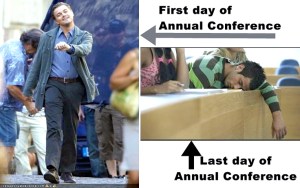
However, I’m still not a fan. There are few things more boring and pointless than sitting in a chair for three hours listening to a speech you’ve heard a hundred times already. I don’t need to listen to a lecture given by someone who has no experience in what I’m doing. I certainly don’t want to spend three or more days at a conference, away from my work and home, lying every time someone asks me about how great the conference is, pseudo-enthusiastically yelling “Hallelujah!” every time a speaker does so, and then walk away from the whole thing feeling emptier than when I showed up.

When I think of conferences I’m often reminded of a scene from the film Waterworld. The earth is covered with water, but there’s a little girl with a tattoo on her back with instructions to find dry land. Problem is, no one can read the instructions. The bad guys, called “Smokers”, capture the girl. The Smokers live on a big oil tanker and how they get it around is by rowing — hundreds of men sticking long oars out the sides and rowing, just like with the old wooden ships. The leader of the Smokers gives an inspiring speech, holding up the girl in front of everyone, proclaiming that they will find the land and create a great future, etc… After the speech the rowers are so hyped that they get to work immediately and exuberantly. Meanwhile, the leader, still not knowing how to read the instructions, in private with his closest advisors is asked, “So which way we rowin’?” and he replies, “I don’t have a g–d–n clue. Don’t worry, they’ll row for a month before they figure out I’m fakin’ it.”

I’m not suggesting that leaders in conferences are “fakin’ it”. But, I’ve lost count of how many times I’ve come out of a conference hearing attendees proclaiming all the great things they’re going to do after being so encouraged by the conference speakers, and then never doing anything. I remember driving home from a three day Christian men’s conference, my intelligence freshly insulted, and my passenger, a railroad worker, declared, “I’m going to plant a church when I get home!” And I just smiled and thought, “No, you’re not.” Because anyone making a major decision like that, in an emotionally charged atmosphere such as a conference, is never thinking straight. And he never did plant that church.

The more honest attendees will be more level-headed, or even discouraged. I’ve known several people, who were already doing some kind of ministry, come out of a Christian conference feeling small and unimportant. I’ve heard laments like, “My ministry is hard work, and I wish I would have been able to meet people at the conference who were going through the same struggles I am, so that I could have talked with them and gotten to know them. But there was no time for that. Instead we just listened to grand speeches which included things like the leader yelling, ‘This is just the beginning!!’ over and over. What’s the point in that?”

My last article, Andragogy (Adult Learning), points out how adults, when attending a class or a conference, are not interested in generalities. They want specific teaching which directly relates to what they’re doing in life. They also don’t want to just sit and listen to a lecturer without having their own life experience and knowledge taken into account. What adult wants to sit and listen to a lecture that would better be delivered to a group of twelve year olds? Adults need to engage and speak and share. I know from personal experience that I would much rather sit in a small group setting, where everyone can participate, than sit in a large conference setting where you just, well, sit.

In Relationship (Part Six)

trinity1Trinity Vs. Triangulation 

“A real Christian is a person who can give his pet parrot to the town gossip.”

~Billy Graham

Do you have any relationships which are entirely based on gossip?

I remember a few years back starting a new job at a fairly large construction company. I was already a fully licensed electrician but the owners had me work along side some long-time employees so that I could learn the ropes as to how things ran at this particular company.

I was surprised at the amount of gossip and dissension I heard from these guys. They would talk bad about each other and talk even worse about the owners. When I was with employees A and B, they would bash employee C. When I was with B and C, they would bash A. This would go on day after day, the same conversations over and over again.

After a time I was given my own work truck, my own helper, and my own jobs — I no longer had to work with these guys. Five years later we hit a slow period and the owners put different crews together on the same jobs to keep everyone working. Once again I was working along side these gossipers. It was a shock to me to hear them still having the same conversations, still bashing each other behind their backs, still with the same complaints about the owners. After five years nothing had changed! Actually there was one noticeable change — all of them had more grey hair. I remember thinking, “These guys are stuck in kind of hell”.

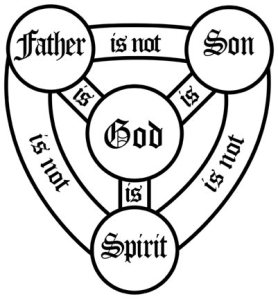
Begotten from the Father came the Son, and a relationship exists between the two. That relationship is the third person of the trinity: the Holy Spirit. (See Jonathan Edward’s essay on the trinity.)

Within the trinity, all three members (Father, Son, and Holy Spirit) are giving themselves to the other members. The Father does everything He does for the Son. The Son does everything He does for the Father. The Holy Spirit does everything He does for the Father and the son. This is a covenant relationship, the first covenant relationship. All true covenant relationships are based on the trinity.

But what would happen if the Father and the Son got together to attack the Holy Spirit? Or the Spirit and the Son to attack the Father? The God of the bible would be no more, and all that exists would be no more. God’s own relationship within Himself is essential for all life.

When I and another have a common enemy, even if he and I would not ordinarily form a relationship, we will form a relationship for the purposes of attacking our common enemy. This is called triangulation.

The best and most common example of triangulation I can give is the one of gossip above. Two people, whose relationship is based solely on the attack of a third person, joining forces for only as long as the third person is a threat. Once the third person is gone, the relationship is over. This is anti-relationship.

The problem with gossip is that it is so compelling. What better way to boost yourself up than by bringing another down, especially when the other is not even able to defend themself at that.

That life only leads to misery. Better to give yourself in a covenant and live than die in the loneliness of triangulation.

In Relationship ~ Part One; Two; Three; Four; Five

In Relationship (Part Five)

goldenwizard10

Rules and Expectations

“There are no rules of architecture for a castle in the clouds.”

~G.K. Chesterton

I have three rules for my kids: No fighting. No crying unless you’re genuinely hurt. Don’t touch my stuff. Apart from that they pretty much have free reign. A pastor friend once told me that at his old house he had a large backyard. At first there was no fence around the yard and he noticed his children would only play near the house. Soon after he built a fence, and the children began to play all over the yard. Once they knew where it was safe to go, they were free to enjoy the whole area.

We need to know the rules of the game if we are going to be able to function in our relationships. Have you ever broken a rule, but didn’t know that you broke it until after you broke it? Have you ever been in a situation where the rules were not equally applied to each person? It’s frustrating isn’t it? It fact, it can be maddening.

“Even more than they need goods, people want for their contentment a full understanding of their condition. None can find comfort in a position which he fails to comprehend, and protracted perplexity leads to mental derangement.

Perplexity of Rats and Dogs

“Even rats and dogs cannot live in perplexity. Take three sets of rats: give one set a meal a day; give the other set the same meal only every second day; and restrict the third group to a meal on every third day. All three groups will thrive; the rich, the middle-class and the poor will get on equally well. But take a fourth set of rats and feed them at periods varying irregularly between one and three days and you will see the rats of this set die. They get more than the poor rats, yet while those prosper on their meager diet they perish because their organism is thrown into a state of confusion, all their reflexes of digestion are dislocated, they die of perplexity.

“Dogs are more human than rats, and so the experiment by which Pavlov drove his dogs mad shows us even more closely what is wrong with ourselves. He trained a dog to expect food when a luminous circle appeared on a screen, and to recognize that no food would come when a flat ellipse with a ratio of semiaxis 2:1 was produced. The dog learned to differentiate precisely between the circle and the ellipse, showing signs of appetite when the former, not when the latter was shown. The shape of the ellipse was then approximated by stages to that of the circle (ratios of the semiaxis 3:2, 4:3 and so on) and the training of discrimination continued through the successive ellipses. The dog found it increasingly difficult to distinguish between the ellipses and the circle and finally, when the ellipse was given a ratio of 9:8 he became quite uncertain in his discrimination. But Pavlov tried to educate him to the limit and continued with this experiment for three weeks. The result, however, was no improvement in the dog’s training but a total breakdown of his discriminating power. At the end he could not see the difference even between the flat 2:1 ellipse and the circle. The dog’s behaviour also underwent a complete change. It began to squeal in its stand, kept wriggling about, tore off with his teeth the apparatus and bit through various tubes. In short, as Pavlov says, it fell into the condition of an acute neurosis.

“This dog broke down when his powers of understanding were overstrained. They were overstrained when it became too difficult for him to distinguish between the symbols signifying food and hunger. His happiness was destroyed, not by need of supplies but by what Pavlov describes as a conflict between excitation and inhibition which its brain found too difficult to resolve.” (Taken from Visual Presentation of Social Matters by Michael Polanyi.)

If I can’t predict the actions of the other parties in a working relationship, I cannot pursue any of my goals. The relationship breaks down, and I will most likely leave, but not after suffering much frustration.

A contract protects people from this ever happening. A covenant does as well, but for different reasons. In a contract there is a “higher power” (the law court) which can be appealed to if one party does not fulfill its predicted duties. In a covenant, each party is at all times fully giving themselves to the other, so there is nothing unpredictable about it.

The problem of unpredictability can really only happen in one of two kinds of relationships: charity or master/slave — where one party holds all the resources over the other. A slave does not have any options in this situation. A receiver of charity, however, can move on to find new donors.

In Relationship ~ Part One; Two; Three; Four; Six; Seven

In Relationship (Part Four)

covenant-quotes-001The Rarity of Covenants

“Asking for a definition of ‘covenant’ is something like asking for a definition of ‘mother'” 

~O. Palmer Robertson

Covenant is not a word to take lightly. If you say you are in covenant with someone, you’d be wise to know exactly what you are saying.

It’s easy to imagine a perfect circle. You can talk about it, analyze it, and theorize about it. But, until you actually draw it, it is just an idea. How many times do we come up with great ideas and then just stop there thinking our work is done. Ever been to a board meeting?

It is the same with the idea of covenant. It is easy to talk about, but extremely difficult to do. Covenants are rare.

So who actually enters into covenants? Families do: husbands and wives, parents and children, brothers and sisters, etc…

Members of organizations do not enter into covenants. They can say they do until their faces turn blue, but all you have to do is observe their actions for a little while and you’ll see that it is not true. Until one is willing to become family to another, he will be in a contractual relationship, or any other kind of relationship other than covenant.

Outside of covenant, before vision, before passion, and before loyalty, one is motivated by selfish desires. These selfish desires are not evil in and of themselves, they are naturally human. When these selfish desires lead one to do evil things, then they become harmful. But, how many people, who have done good and noble things, have not started out with selfish desires?

One member of an organization can say he’s in covenant with another. He can say that he values the success of the other over his own. He can hold himself as an example of what healthy covenants look like. He can do all that talking, but really he is putting his own selfish desires first. And that’s okay, as long as he is honest about it.

Charles Spurgeon said, “Sincerity makes the very least person to be of more value than the most talented hypocrite.” Even though one cannot be perfect in his covenant vows, if he is sincere in his actions he is a true covenant keeper. One who merely says he is in covenant, but does not act accordingly, is nothing more than a hypocrite.

This is especially true for leaders. Leaders have the “raw end of the deal” in the covenant. Like God, they have to be the better, stronger member of the covenant. Like God, it is up to them to define the terms of the covenant. Our covenants with each other must image God’s covenant with us.

“A covenant is a bond in blood sovereignly administered. When God enters into a covenantal relationship with men, he sovereignly institutes a life-and-death bond. A covenant is a bond in blood, or a bond of life and death, sovereignly administered.” (O. Palmer Robertson, The Christ of the Covenants [Phillipsburg, NJ: Presbyterian and Reformed Publishing, 1980], pg. 4)

Robertson gives three main attributes to a covenant:

  1. It is a bond — Covenant members are bound together in relationship and this bond is sealed with a binding oath (sometimes verbal, sometimes by symbolic action) by both parties. No oath = no bond = no covenant.
  2. It is a bond in blood — “By initiating covenants, God never enters into a casual or informal relationship with man. Instead, the implications of his bonds extend to the ultimate issues of life and death” (pg. 7-8). James B. Jordan has pointed out that the cutting in half of the animals in Genesis 15 was not so much God saying, “Let this happen to me if I don’t uphold my end of the covenant,” but rather, the cutting in half of the animals symbolized the death and resurrection of humanity. The new life was made possible by the covenant — just like with Adam, who “died”, was cut in two, and was resurrected to find a new covenant partner waiting for him: his wife. The same happened to Jesus. A covenant bond in blood is a familial bond — a bond where one dies to his old self and is reborn as something new.
  3. It is a bond in blood sovereignly administered — “Both biblical and extra-biblical evidence point to the unilateral form of covenant establishment. No such thing as bargaining, bartering, or contracting characterizes the divine covenants of Scripture. The sovereign Lord of heaven and earth dictates the terms of his covenant” (pg. 15). Covenants often involve a weaker party and a stronger party. Who determines the conditions of the covenant? The stronger party does. This is not a master/slave relationship — the stronger party wants the weaker to prosper and is willing to expend his own resources and time to make that happen.

As you can see above, covenants are no small matter, and to use the term lightly is foolish. If you can’t conform to the attributes of covenant listed above, then you can’t enter into covenant, and must not say that you have.

Sometimes it is best to enter into a different type of relationship. It all depends on what the circumstances are. The important thing is to make clear the kind of relationship all parties are entering into right from the start. This will prevent any confusion and contention between the parties in the future.

In Relationship ~ Part One; Part Two; Part Three; Part Five