In Relationship (Part Four)

covenant-quotes-001The Rarity of Covenants

“Asking for a definition of ‘covenant’ is something like asking for a definition of ‘mother'” 

~O. Palmer Robertson

Covenant is not a word to take lightly. If you say you are in covenant with someone, you’d be wise to know exactly what you are saying.

It’s easy to imagine a perfect circle. You can talk about it, analyze it, and theorize about it. But, until you actually draw it, it is just an idea. How many times do we come up with great ideas and then just stop there thinking our work is done. Ever been to a board meeting?

It is the same with the idea of covenant. It is easy to talk about, but extremely difficult to do. Covenants are rare.

So who actually enters into covenants? Families do: husbands and wives, parents and children, brothers and sisters, etc…

Members of organizations do not enter into covenants. They can say they do until their faces turn blue, but all you have to do is observe their actions for a little while and you’ll see that it is not true. Until one is willing to become family to another, he will be in a contractual relationship, or any other kind of relationship other than covenant.

Outside of covenant, before vision, before passion, and before loyalty, one is motivated by selfish desires. These selfish desires are not evil in and of themselves, they are naturally human. When these selfish desires lead one to do evil things, then they become harmful. But, how many people, who have done good and noble things, have not started out with selfish desires?

One member of an organization can say he’s in covenant with another. He can say that he values the success of the other over his own. He can hold himself as an example of what healthy covenants look like. He can do all that talking, but really he is putting his own selfish desires first. And that’s okay, as long as he is honest about it.

Charles Spurgeon said, “Sincerity makes the very least person to be of more value than the most talented hypocrite.” Even though one cannot be perfect in his covenant vows, if he is sincere in his actions he is a true covenant keeper. One who merely says he is in covenant, but does not act accordingly, is nothing more than a hypocrite.

This is especially true for leaders. Leaders have the “raw end of the deal” in the covenant. Like God, they have to be the better, stronger member of the covenant. Like God, it is up to them to define the terms of the covenant. Our covenants with each other must image God’s covenant with us.

“A covenant is a bond in blood sovereignly administered. When God enters into a covenantal relationship with men, he sovereignly institutes a life-and-death bond. A covenant is a bond in blood, or a bond of life and death, sovereignly administered.” (O. Palmer Robertson, The Christ of the Covenants [Phillipsburg, NJ: Presbyterian and Reformed Publishing, 1980], pg. 4)

Robertson gives three main attributes to a covenant:

  1. It is a bond — Covenant members are bound together in relationship and this bond is sealed with a binding oath (sometimes verbal, sometimes by symbolic action) by both parties. No oath = no bond = no covenant.
  2. It is a bond in blood — “By initiating covenants, God never enters into a casual or informal relationship with man. Instead, the implications of his bonds extend to the ultimate issues of life and death” (pg. 7-8). James B. Jordan has pointed out that the cutting in half of the animals in Genesis 15 was not so much God saying, “Let this happen to me if I don’t uphold my end of the covenant,” but rather, the cutting in half of the animals symbolized the death and resurrection of humanity. The new life was made possible by the covenant — just like with Adam, who “died”, was cut in two, and was resurrected to find a new covenant partner waiting for him: his wife. The same happened to Jesus. A covenant bond in blood is a familial bond — a bond where one dies to his old self and is reborn as something new.
  3. It is a bond in blood sovereignly administered — “Both biblical and extra-biblical evidence point to the unilateral form of covenant establishment. No such thing as bargaining, bartering, or contracting characterizes the divine covenants of Scripture. The sovereign Lord of heaven and earth dictates the terms of his covenant” (pg. 15). Covenants often involve a weaker party and a stronger party. Who determines the conditions of the covenant? The stronger party does. This is not a master/slave relationship — the stronger party wants the weaker to prosper and is willing to expend his own resources and time to make that happen.

As you can see above, covenants are no small matter, and to use the term lightly is foolish. If you can’t conform to the attributes of covenant listed above, then you can’t enter into covenant, and must not say that you have.

Sometimes it is best to enter into a different type of relationship. It all depends on what the circumstances are. The important thing is to make clear the kind of relationship all parties are entering into right from the start. This will prevent any confusion and contention between the parties in the future.

In Relationship ~ Part One; Part Two; Part Three; Part Five

In Relationship (Part Three)

friendOther Kinds of Relationships

“Friendship is unnecessary, like philosophy, like art… It has no survival value; rather it is one of those things that give value to survival.”

~C.S. Lewis

There are other types of working relationships besides covenants and contracts. Each of these different kinds of relationships may have certain aspects of covenants or contracts, but they are wholly different. The four main types of working relationships that I can think of are:

1. Friendships

  • These relationships consist of one or more people who have common interests. The parties aren’t looking at each other (like lovers), but rather are standing side by side looking forward (see C.S. Lewis’s The Four Loves).
  • The duties of the parties in a friendship will include covenant-like expectations, but there is no ritual or ceremony formalizing these expectations. They are implicit.
  • Friendships might last a life time, or not. The duration of the friendship is never discussed. Friendships will end when the commonality between the parties fades away. This might happen when one party has a major worldview change (like becoming religious), when one party matures faster than the other(s), or it might simply happen when one party moves to a new physical location.

2. Charity

  • One party is in need, and another fills that need.
  • Like in a contract, one party needs the other’s resources.
  • Like in a covenant, one party cannot “pay back” the other.
  • The lifespan of this relationship can last a long time or a short time — it depends on the giver’s generosity and the receiver’s need.
  • There are no expectations in charity, except that the giver may want his gift to be used for a specific thing. That specific thing must be determined by the receiver — if it is determined by the giver, it is no longer charity, but a contract. If the receiver does not meet the giver’s expectations, the giver does not get his gift back.

3. Master/Slave

  • The slave simply must do what the master requires as his life depends on it.
  • The master must only care for the slave as long as he wants the slave to be an effective and hard worker.
  • The relationship will last as long as the master wants it to, or until one party dies. The slave cannot determine the length of the relationship unless the master introduces some contractual conditions.
  • There is nothing covenantal in the master/slave relationship. As soon as this relationship takes on covenantal properties, it ceases to be a master/slave relationship.

4. Neighbours

  • This relationship is based solely on the physical proximity of the parities and will only last as long as the parties are near each other (living side by side, driving side by side, waiting in line side by side, etc…).
  • There are certain implicit rules, depending on culture, which both parties will be expected to follow. These rules will (should) be common sense and common knowledge.

There is also a non-working relationship: Acquaintanceship. Acquaintances know each other, but they are not friends, and there is no expectations in that relationship at all, other than basic politeness and neighbourliness when required.

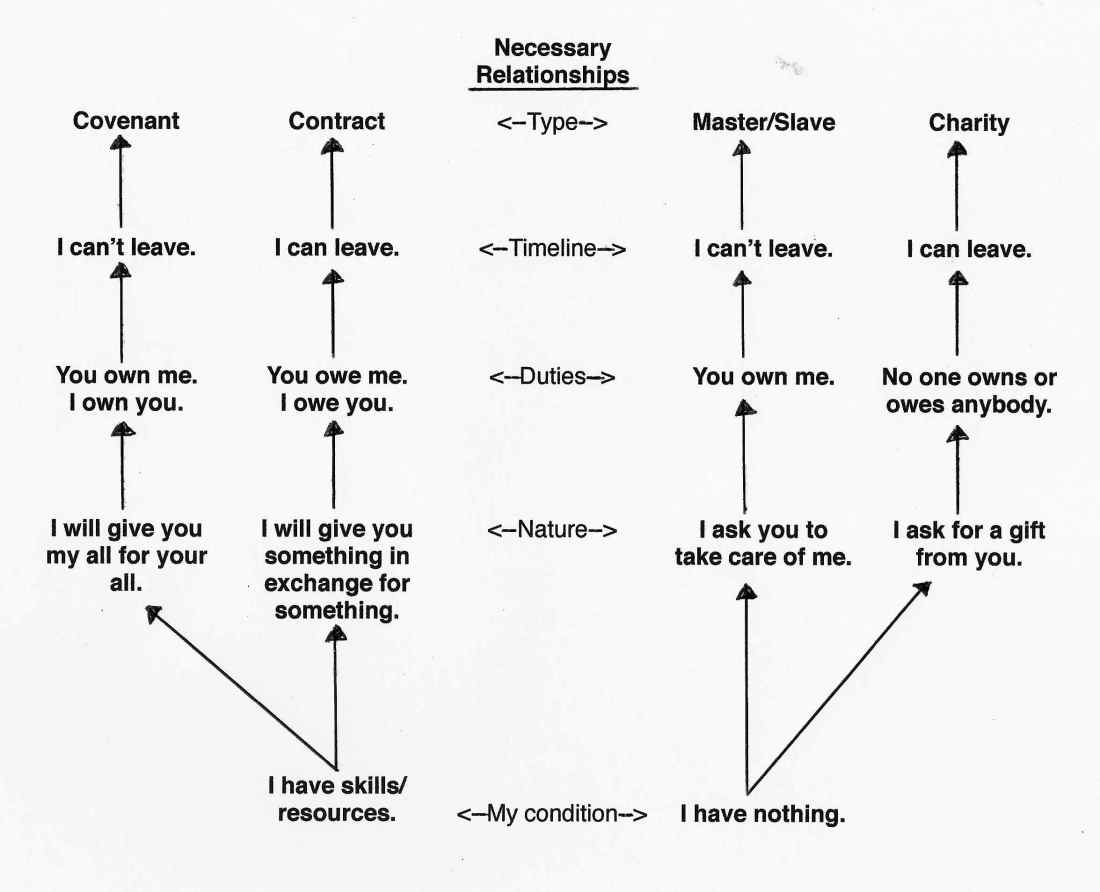
relationship diagram sm

The diagram above shows what I believe are the four necessary relationships. You simply cannot function in this world unless you are in one or more types of these relationships.

The three types of relationships I would consider to be unnecessary (you can survive without them) would be friends, neighbours, and acquaintances. Acquaintances would be, I think, the most shallow of these three.

And then of course there are all the familial relationships: parents, brothers/sisters, cousins, aunts/uncles, etc…. However, I think many of these relationships can fit into one of the three unnecessary relationships. How many of your cousins are merely acquaintances? If you’re like me, most are. Brothers and sisters would often fall into a covenantal relationship — even if those relationships are off and on over the years. The parent/child relationship is of course unique. A child is not a fully developed person, and so, cannot know how to decide to act in any relationship, other than what he is taught. A parent/child relationship is not charity. Any parent who would consider taking care of their own child an act of charity is simply a bad parent.

I suppose two other kinds of relationships we could mention are teacher/student and colleagues. But again, we can fit those into previously mentioned types of relationships — teacher/student is a contract, and colleagues can easily fit into neighbour or acquaintance in relation to each other, combined with contract in relation to a common employer. If one is training and teaching a colleague, that is a contract — not between the colleagues, but between the employer and the trainer.

In Relationship ~ Part One

In Relationship ~ Part Two

In Relationship ~ Part Four

In Relationship (Part Two)

www.cartoonstock.com-cartoonview.asp?catref=tcrn148Covenant Vs. Contract

“Here beyond men’s judgments all covenants were brittle.”

~Cormac McCarthy

Here’s Eugen Rosenstock-Huessy’s take on covenants and contracts:

“In a sale the two partners to the contract think of their own advantage. The whole content of a real marriage might be summed up in the statement that the two who are partners are each expected to care more for the other partner’s happiness than their own! No marriage could survive twenty-four hours if the couple should apply the rule of the law of contracts to their common life. While in business everybody minds his own business, in any dual [relationship] one partner minds the other partner’s business. A wife shall care for her man’s health more than for her own, and her husband shall care more for her comfort than for his own. To judge a marriage on the basis of the law of contract is an aberration from logical thinking.

“There is another side to the question. The duties derived from a contract are fixed in the beginning. The duties in any true [covenant] partnership are in permanent flux; they are the result not of the words spoken at the beginning but of the acts of the partners to the relationship while it lasts. These actions have a polarizing effect upon the two. The more you become my friend, the more I shall become yours. The mutual dependance is graded, and in the normal evolution of dual relations the two individuals are more and more encircled and transformed into the foci of one eclipse. Consequently, the action of each partner is shaping the form of the dual [relationship]. The polarity is established more definitely each time.

“Finally, the two are agents of a corporate body for which they stand, for from it they derive their activities. This becomes very clear in cases of absence or death of one partner. Then not only does one try to represent the other but also the general reaction of the partner who is left behind is that of stressing the point of view, the line of action, and the interest of the partner who has passed away. In a contract, however, I am free when the other party ceases to exist. It is a pluralistic or individualistic arrangement. Under the dual [arrangement] I am spell bound by the law of polarization. I remain the other half the more my second self is in decline or is prevented from taking his place.

“So we can say that a contract by which one party surrenders to the other would be void. Contracts are and must remain temporary arrangements for the individual forms of our existence, fleeting conglomerations for work and against nature outside. But in matrimony a wife surrenders her beauty and health to her husband for better, for worse. And the man surrenders his adventures, his infinite chances. How can such a perilous exposure of the whole being be treated as the result of a willful arrangement between two individuals? In a contract I try to get as much as possible, and to remain as unchanged as possible. In any partnership [covenant] I throw in my lot today without knowing where I shall be tomorrow.

~The Multiformity of Man (Norwich, VT: Argo Books [1936] 1973), pp. 54-55 (emphasis mine).

In my last post, I focused on loyalty mainly in the context of a contract. In a contract one will stay loyal so long as the other party is living up to their end of the deal. In a covenant, however, one will stay loyal so long as the other party is still alive, and perhaps even beyond that as Rosenstock-Huessy suggests above.

There are three main differences between covenants and contracts as Rosenstock-Huesy lists in the quote…

  1. A contract will have the duties listed for both parties at the beginning of the arrangement. Once those duties are fulfilled, the contract is over. The duties of a covenant are ever changing as the covenant is an unending agreement. What the parties agree to at the start of the covenant is to stay loyal to the covenant.
  2. Contracts must be temporary. Covenants must be permanent.
  3. In a contract my motives are purely selfish as I try to get as much as possible out of the deal, and I try to change as little as possible while satisfying my duties in the deal. In a covenant, I give up my selfish ambitions for the sake of the other party. I do change in the present and over time in order to meet the needs of my partner.

To stay loyal in a covenant is entirely up to me. I commit myself to my partner even if he/she cannot fulfill his/her duties.

Not all covenants are created equal. Not all relationships must be covenants. That isn’t even realistic. Sometimes a contract makes more sense. Don’t enter into a contract and then hold the other party to the conditions of a covenant. If you’re expected to fulfill certain duties in exchange for the resources of the other party, don’t get angry when, as you neglect your duties, you don’t receive their resources. Don’t enter into a covenant and treat it as a contract. If your wife breaks her leg and can’t cook for six weeks, that doesn’t mean you don’t have to fulfill your husbandly duties for those weeks.

I’ve noticed that when politics get ugly within an organization sometimes it is because there is not a clear definition of the relationship. One party thinks they’re in a covenant, while the other thinks they’re in a contract. Or, they both agree what kind of relationship they’re in, but the definitions of contract and covenant are not clearly known by one or both parties.

I’ve heard before that the difference between a contract and covenant is that a contract is 50/50, while a covenant is 100/100. But actually, a contract is 100/100 too. The difference is what the 100 refers to and for how long.

Enter a contract when…

  • …you want to pursue your own agenda and you need someone else’s resources to do so.
  • …you don’t want to be attached to the other party indefinitely.
  • …you want to be free from your obligation if the other party does not fulfill theirs.

Enter a covenant when…

  • …you want the other party to prosper over and above yourself.
  • …you want a life long relationship, for better or for worse.
  • …you’re willing to uphold the covenant, and its purpose, even when your partner cannot do the same.

Obviously, contracts and covenants are quite different, and you don’t want to enter into one when you should be entering into the other. Know what you want first and choose wisely.

In Relationship ~ Part One

In Relationship ~ Part Three

In Relationship (Part One)

www.cartoonstock.com-cartoonview.asp?catref=llan448Staying Loyal

“If something cannot go on forever, it will stop” ~Herbert Stein’s law

If you’re going to stay loyal to an organization you really have to love that organization. You have to love its philosophy, its theology, vision, structure of government, mandate, etc… If you don’t love it, you can not last.

John Boyd wrote that, as individuals, our basic goal is “to improve our capacity for independent action”*. In order to fulfill this goal we can not work alone. We have to cooperate with others. Boyd continues…

“The degree to which we cooperate, or compete, with others is driven by the need to satisfy this basic goal. If we believe that it is not possible to satisfy it alone, without help from others, history shows us that we will agree to constraints upon our independent action—in order to collectively pool skills and talents in the form of nations, corporations, labor unions, mafias, etc.—so that obstacles standing in the way of the basic goal can either be removed or overcome. On the otherhand, if the group cannot or does not attempt to overcome obstacles deemed important to many (or possibly any) of its individual members, the group must risk losing these alienated members. Under these circumstances, the alienated members may dissolve their relationship and remain independent, form a group of their own, or join another collective body in order to improve their capacity for independent action.”

Taking that into account, we can also say that if one is going to stay loyal, one has to feel as though he is able to pursue his own individual goals while belonging to the organization. If he feels he cannot do that, he will either leave or stay as an unhappy member of the group.

Being loyal does not just mean staying with the group. Being loyal means contending for the group in its mission and mandate. If one does not love, or fit in with, the mission or the mandate, then one cannot contend for the organization.

Sometimes, if the leadership has forgotten the original mission, a disgruntled member of the group (perhaps a “Man of Words“) may speak out to remind them. That person may seem like a rebel, but really he is contending for the organization. An organization, once it has initially fulfilled its mission, may turn to other ventures in order to survive. The original, fanatical, leadership may consider the survival (the continued existence) of the organization to be more important than its original mission.** This change in venue may restrict the individual members from achieving their independent goals which, up till that point, lined up with the organization’s original mission.

Other times, however, the members of the group, in their foolhardy zeal to just do something, may have misread the intentions of the organization right from the start. Sometimes the leadership does not make its intentions clear at the beginning because, they too, are looking to pursue an individual goal. If an organization’s leaders can use the members to achieve what they as leaders want, once that achievement is accomplished, they may have no more use for those members, and the members will find that their opportunity for accomplishing their own independent goals has evaporated.

The ideal situation then is when “skills and talents are pooled, (and) the removal or overcoming of obstacles represents an improved capacity for independent action for all.”

Loyalty happens…

  • …when the intentions (re: mission, mandate, theology, system of government, etc…) of both the leadership and the members are clearly stated and understood right from the beginning.
  • …when both the leaders and the members feel that they can successfully pursue their own independent goals.
  • …when, as things change over time, a clear and honest line of communication is kept between the leadership and its members.
  • …when the survival of the organization does not outweigh the mission and the mandate of the organization.

*Destruction and Creation by John R. Boyd

**You know this is happening when the leadership starts to lie about how successful the organization is.

In Relationship ~ Part Two

In Relationship ~ Part Three


Blue

movie-logo

Blue (Blue Beats Green) Movie

For anyone interested in listening to a different perspective on the environmental issues we face today, watch the film.


  • Update December 11, 2015…

I guess no one was interested in listening to a different perspective.

blue shutdown

But, you can still watch it on Vimeo…