If you live in the west and travel to the east, you have to be careful with the electrical devices you bring.
In the west, the voltage at an outlet is 120 volts, whereas in the east it will be 220 volts. If you plug your western electric razor in without an adaptor, you will fry your razor.
I like to use this illustration when teaching hermeneutics. You have to be careful when taking texts written thousands of years ago and applying them to today’s world.
All the so called “end-times” texts come to mind. When someone writes “the end of all things is at hand” two thousand years ago (1 Peter 4:7*), you don’t read that in 2015 and go out into the streets shouting the end is near.
You have to figure out what the original author meant by his words. What was coming to an end for him two thousand years ago? Then, once you’ve figured out his meaning, you can then apply the principles of what he was saying to your own time.
Sometimes you can take texts and plug them right in without the transformer (like with the wisdom literature), but the bible itself will teach you when and when not to do that.
And… just plain common sense.
*Also see: 1 Corinthians 10:11; James 5:7-9; 1 John 2:18; Hebrews 10:25; Jude 17-18.
The German Christian philosopher, Eugen Rosenstock-Huessy, taught that societies can be classified into three different stages: tribes, kingdoms, and empires.
The simplest form of society is the tribe. A tribe is a small group of people held together by a common attribute, like family. Tribes are suspicious of outsiders and tend to stay within their own boundaries. Tribes resist change. Tribes also look into the past and tend to worship their ancestors.
As a society matures, the different tribes bind together to form a kingdom. Because there are now many different people with different viewpoints, a higher culture can develop. Kingdoms tend to worship through temples and looking to the heavens.
Nations can fall into either kingdoms or empires. Whereas a nation refers to a people with common descent and culture, a kingdom will consist of one nation, and an empire will consist of many nations. Cambodia is a kingdom with one nation: the Khmer people. There are some minority groups of Vietnamese, Chinese, and Barang (white people), but the overwhelming majority is Khmer. Canada, however, is a multi-national country. Looking at things this way, Cambodia is a kingdom and Canada is an empire.
As a society matures beyond the kingdom stage, the nations join to form an empire. The empire, though consisting of many nations, must have a common religion or worldview in order to stay cohesive. Without a common “worship” center, the empire becomes multicultural, which doesn’t work. Worship is still through the temple, but despite all the different kinds of peoples and languages, the temple must be the same for all. Rome didn’t care which religion you held to as long as Caesar was the common god for all and over all.
Multiculturalism does not work because you can not have a whole bunch of people living together believing all sorts of different things. It sounds good, but it does not work in real life. People who would disagree and defend multiculturalism are people who don’t really believe in anything, or are at least blind to the fact that they have themselves elevated their particular worldview above all others.
The story of the blind men and the elephant comes to mind. Each man is in touch with one part of the elephant and believes his part is the whole, but of course it is not. Multiculturalists point out that each religion or worldview is like each blind man, each with a part of the truth but not the whole. Therefore, we can all live in peace if we accept the fact that none of us knows the whole truth. The problem with that idea is that the multiculturalist, in order to know each religion/worldview only sees a part of the whole, has to himself see the whole elephant, which is just what he claims is impossible.
It’s easy to put a “coexist” bumper sticker on your car and then only associate with people who believe the same as you believe. Enter tribalism. If multiple belief systems are allowed to pervade the empire, people will form small groups where they feel they can belong, and the empire breaks down to the most primitive form of society again.
Canada would actually be better off (in the short run) to become completely atheist. Rather than trying to force several different belief systems into a doomed syncretistic society, it would be healthier to unify under one banner… in the short run.
And this is the cause of all the political conflict in the west today. Each worldview is fighting to be on top. Christians, Muslims, atheists, multiculturalists, etc… all want everyone else to believe what they believe. That, in itself, is perfectly normal. But it’s only right for the one group who actually has the truth to be on top.
I, as a Christian, believe that one truth to be Christianity. I want everyone to believe as I believe. Is this bad? No, it’s normal. I don’t want tribalism — I don’t want to just hang out with people who are just like me. I don’t want a mono-national kingdom — I don’t want to just be surrounded by people who dress the same, talk the same, and sing the same. I want an empire — a multi-national society with many different variations unified under a common religion. A true Christian empire can only form by the bond of the Holy Spirit who creates a single (yet complex) culture.
But, this kind of empire does not (yet) exist in any part of the world. For better or for worse, western christendom took a run at it, but that attempt is fizzling out now. Tribalism seems to be on the rise in the west. The nationstate has failed our expectations and people are turning inward and into smaller groups to solve their problems.
Western Christians lament at the “fall” of Christianity. Some complain of persecution. (Western Christians have never experienced persecution.) A lot believe the end is near. There isn’t a whole lot of positive feeling for the future.
Many are turning to politics for salvation. “If we could just get the right people in office, that would solve these problems. We need someone tough, who won’t listen to the opposition’s ideas.” While certain levels of tribalism is often a welcome thing in a church (we all need a family), it becomes destructive when combined with us-versus-them secular politics.
Jesus is calling everyone into His kingdom. That kingdom is not of this world (although it is invading this world). No one should be turned away from the Church just because his political views differ from those of the majority of the current members. The politics of Jesus are above ours. Only Jesus is qualified to be the emperor, the king, and the tribal leader all at once.
In the western multicultural neo-tribal society, Christians are called to work beyond the confines of right-wing/left-wing politics — challenging culture where it opposes God’s plan and promoting culture where it conforms to God’s plan. Those who don’t believe in Jesus should be happy when Christians are at work in a society, because they know there will be change for the better. When one does oppose Christianity, let it be because he hates the truth of it, rather than because he hates those who promote it.
Tim Keller is one of the most successful pastors in North America. His church is in New York city, one of the most difficult places to start up a new church. Here is his take on church and politics…
“The men of words are of diverse types. They can be priests, scribes, prophets, writers, artists, professors, students and intellectuals in general… Whatever the type, there is a deep-seated craving common to almost all men of words which determines their attitude to prevailing order. It is a craving for recognition; a craving for a clearly marked status above the common run of humanity.”
~Eric Hoffer
“Mass movements do not usually rise until the prevailing order has been discredited. The discrediting is not an automatic result of the blunders and abuses of those in power, but the deliberate work of men of words with a grievance. Where the articulate are absent or without a grievance, the prevailing dispensation, though incompetent and corrupt, may continue in power until it falls and crumbles of itself.” (“The True Believer”, by Eric Hoffer, HarperCollins Publishing, New York, pg. 130)
Here Hoffer is describing the climate of a society before a mass movement begins, but I think we can also apply this statement to a mass movement that has passed its “dynamic stage” but the original fanatical leadership has not yet stepped down, and is in fact doing damage to the movement. The men of words can rise up again at this stage in the movement, inspiring the masses to change the leadership to a practical man of action.
“The preliminary work of undermining existing institutions, of familiarizing the masses with the idea of change, and of creating receptivity to a new faith, can be done only by men who are, first and foremost, talkers or writers and are recognized as such by all. As long as the existing order functions in a more or less orderly fashion, the masses remain basically conservative. They can think of reform but not of total innovation. The fanatical extremist, no matter how eloquent, strikes them as dangerous, traitorous, or even insane. They will not listen to him…
“Things are different in the case of the typical man of words. The masses listen to him because they know that his words, however urgent, cannot have immediate results. The authorities either ignore him or use mild methods to muzzle him. Thus imperceptibly the man of words undermines established institutions, discredits those in power, weakens prevailing beliefs and loyalties, and sets the stage for the rise of a mass movement.” (pp. 130-131)
Again, even after the movement has begun and has been running for several years, the men of words can do the same thing to the established authority of whomever started the movement. As shown in my last article about Hoffer’s book, the most important people to the leadership of a mass movement are the lieutenants. It is these lieutenants that can and should be swayed by the man of words if one wants to see a change in leadership.
What is a man of words like?
“There is apparently an irremediable insecurity at the core of every intellectual (man of words), be he noncreative or creative. Even the most gifted and prolific seem to live a life of eternal self-doubting and have to prove their worth anew each day.
“‘…he has much more vanity than ambition; and he prefers consideration to obedience, and the appearance of power to power itself. Consult him constantly, and then do just as you please. He will take more notice of your deference to him than of your actions.’ (Hoffer quotes Alexis de Tocqueville, Recollections [New York: Macmillan Company, 1896], pg. 331.)” (pp. 132-133)
The man of words is fickle, pledging loyalty to whomever will give him an ear.
“However much the protesting man of words sees himself as the champion of the downtrodden and injured, the grievance which animates him is, with very few exceptions, private and personal. His pity is usually hatched out of his hatred for the powers that be.” However, “When his superior status is suitably acknowledged by those in power, the man of words usually finds all kinds of lofty reasons for siding with the strong against the weak.” (pp. 133-134)
“It is easy to see how the faultfinding man of words, by persistent ridicule and denunciation, shakes prevailing beliefs and loyalties, and familiarizes the masses with the idea of change. What is not so obvious is the process by which the discrediting of existing beliefs and institutions makes possible the rise of a new fanatic faith.
“The genuine man of words himself can get along without faith in absolutes. He values the search for truth as much as truth itself. He delights in the clash of thought and in the give-and-take of controversy.” (pp. 139-140)
But, the future that the man of words hopes for, a society of free thinking people, is usually not what comes. Rather, what is created is a “corporate society that cherishes utmost unity and blind faith.” (pg. 139)
“The tragic figures in the history of a mass movement are often the intellectual precursors (the men of words) who live long enough to see the downfall of the old order by the action of the masses.” (pg. 141)
In this classic work, Thomas Sowell analyzes the two competing visions that shape our debates about the nature of reason, justice, equality, and power: the “constrained” vision, which sees human nature as unchanging and selfish, and the “unconstrained” vision, in which human nature is malleable and perfectible. He describes how these two radically opposed views have manifested themselves in the political controversies of the past two centuries, including such contemporary issues as welfare reform, social justice, and crime.
Here are some of my notes on the book:
Part I ~ Patterns
Our visions shape our theories — visions can not be tested, they are presuppositional, and they tend to be simple.
Our theories can be tested by facts. Facts can not prove theories, but facts do cause us to disregard bad theories.
The Constrained Vision
There are realities about this world that can not be changed. Therefore, rather than wasting time and effort trying to change them, one needs to learn to work within them.
One needs to learn to make the most of the possibilities available within the constraints of reality.
The constrained vision deals in trade-offs — choosing the better option and accepting that there are no ideal options.
When there are people suffering in this world through poverty, war, etc., some would want you to continuously feel bad (or guilty) for those who are suffering — your guilt = their suffering. Thus you will be motivated to help them. The constrained vision says that it is useless for you to continuously “feel” their suffering (and it is unnatural as well) — better to embrace your natural inclination for self-improvement.
Facts = Reality
Virtue = the best possible trade-off/prudence
Your desire for self-improvement forces you to work with and for the benefit of others. Thus, as people work to improve their own lives, they end up working to improve the lives of others — the world becomes better for all people. This improvement is unintentional, but it does happen, and it happens without a human power to plan it.
The leaders need to be educated “down to” the level of the masses.
Self-interest is a better motivator than guilt and it has better results for the suffering too.
People’s selfish desire for self-improvement motivates them to get the job done — this is better than depending a person’s disposition for their motivation.
“Do right because it is in your best interest” rather than “Do right because you know it’s the right thing to do.”
The Unconstrained Vision
We can change the world for the better.
We can change human nature if only: The right people were in charge; The right institutions were created; People were educated properly; etc…
Whereas the Constrained Vision says that bad institutions are a result of flawed humanity, the Unconstrained Vision says that bad institutions are the cause of flawed humanity.
We can feel other people’s needs as well as our own (if not better).
Self-interest is the negative result of bad institutions.
There are individuals who are intelligent enough to know how to fix all our problems, and these individuals should be given the power to do so, even if it causes suffering and limited freedom for the masses.
The masses need to be educated “up to” the level of the leaders.
Idealism = Reality
Virtue = Final solutions to problems
An institution’s intentional benefits to society are the greatest virtue. Unintentional benefits to society are not acknowledged. We can always know what is good/bad for society and why that is so, and plan accordingly.
Note: The way in which Sowell uses the word vision, the word world-view could be used as well.
Note: Constrained Vision does not necessarily equal Conservative while Unconstrained Vision equals Liberal (although that seems to be the norm). One can be a Constrained Conservative or an Unconstrained. For example: a Constrained Conservative would not want to send troops into Iraq as the cost of human life and military resources would be too great for an unpredictable outcome, whereas an Unconstrained Conservative would want to send in troops believing that they could create a successful democracy in Iraq. Or, a Constrained Liberal, although wanting a large government, wants governmental power to be spread out through several government departments, whereas an Unconstrained Liberal wants an “all-knowing” leader to have sovereign control over the decisions affecting society.
Note: Nobody holds 100% to one vision and 0% to the other. There are various degrees between of course. Sowell himself clearly holds to the Constrained Vision.
Knowledge ~ The Constrained Vision
No one person, or small group of individuals, knows enough to make good decisions for society (or even for himself).
The collective knowledge of the culture and its history is best for making decisions.
Even if we don’t know why what is best is best, we can trust the experience of history and can still benefit.
We should be slow to criticize the cultural norms of our society as these norms are built on the experience of millions of people both in the past and in the present.
Defects in society are not in themselves reason for radical change — rational small adjustments over time will give us the best possible options for the future.
Knowledge ~ The Unconstrained Vision
Nothing is sacred just because its old.
Wisdom of the ages = ignorance of today
Old = untrustworthy
Reason and meditation is better than partially explained (or unexplained) historical collective wisdom.
People who hold to old traditional views need to be enlightened before any progress can be made in society.
If history’s collective wisdom is represented by a-x (x being today’s constrained generation; y being today’s unconstrained generation), x is ignorant because a-w is obsolete and irrelevant now.
Whereas with the Constrained Vision a-w is so ingrained into our minds we can’t always explain the wisdom or benefits of it, the Unconstrained Vision only considers y as having the proper knowledge to advance society.
y is the wisdom in the hands of a select few who must then lead society.
Knowledge ~ Reason and Rationality
There are two “kinds” of reason: A) cause and effect; scientific method — B) to justify one’s actions.
In the Constrained Vision A and B are far apart, whereas in the Unconstrained Vision, A and B are closer together.
Constrained Vision: We don’t always know why things are the way they are.
Unconstrained Vision: We know why things are the way they are and we should be able to specify those reasons.
Religion: God is unconstrained while humans are constrained.
Law: With the Constrained Vision laws are something passed down to us by previous generations, and with the Unconstrained Vision laws are seen as something to be invented afresh today.
Sowell quotes Hayek: “The most dangerous state in the growth of civilization may well be that in which man has come to regard all these (old) beliefs as superstitions and refuses to accept or to submit to anything which he does not rationally understand. The rationalist whose reason is not sufficient to teach him those limitations of the power of conscious reason, and who despises all the institutions and customs which have not been consciously designed, would thus become the destroyer of the civilization built upon them.” (F.A. Hayek, The Counter Revolution of Science: Studies on the Abuses of Reason [Indianapolis: Liberty Press, 1979], pp. 162-163.)
Knowledge ~ Social Policy
The Unconstrained Vision wishes to see more economic and social equality among the masses — even if the decision making process to produce that equality is itself unequal –> equality imposed by an unequal power structure.
The Constrained Vision is not so much concerned with societal inequality as it is with inequality in the power structure.
In regards to social planning, with the Constrained Vision, each individual sticks to what he is specialized in and allows the systemic process to determine social outcomes. When each person does his/her part (fulfills his/her role) the systemic process functions normally. If you’re a physicist, stick to physics. If you’re a carpenter, stick to carpentry. You will only corrupt the system if you get involved in areas in which you have no knowledge or experience.
In regards to social planning with the Unconstrained Vision, each person needs to act in ways which they feel will promote equality in all of society. If you’re a business owner, hire people who you feel are at a disadvantage. If you’re a teacher, bring up social issues in your class which you feel the students should be aware of, such as gender equality.
The Constrained Vision sees individuals, for example businessmen, as being unqualified to make decisions for the greater society. The businessman can best serve society by doing what he knows how to do for his own self-interest — the benefits to society will come through the systemic process. If he tries to “fix” society intentionally, he will only do damage.
Knowledge ~ Sincerity Vs. Fidelity
Sincerity is imperative in the Unconstrained Vision. Each individual must be sincere and sincerity = being right.
With the Constrained Vision, sincerity = believing what you’re doing is right. But you may not be right. (Hitler was very sincere.) With the Constrained Vision, fidelity is a virtue –> faithful commitment to one’s role in life within the sphere of one’s competence. Sincerity is not that important.
For example: A constrained judge is loyal to the existing law; an unconstrained judge sincerely wants to change the law for the “greater good”.
Because sincerity is held at such a high regard in the Unconstrained Vision, the sincerity of one who holds to the Constrained Vision is looked on suspiciously — “What are his real motives?” Whereas those who hold to the Constrained Vision are much less concerned with sincerity as the societal system is so complex that even the most sincere person can still be mistaken.
“The first thing a man will do for his ideals is lie.” (Joseph A. Schumpeter, History of Economic Analysis [New York: Oxford University Press, 1954], pg. 96).
Knowledge ~ Youth and Age
Constrained: Wisdom is of the older. Prudence is of the wise.
Unconstrained: Youth are unstained by the past prejudices and therefore are more capable of embracing new and better ideas.
Social Processes
Order and design –> some processes are more ordered than others –> Like a wild growing of vegetation versus a planned garden.
Social Processes ~ The Constrained Vision
There is no designer, but yet the processes work.
Like language — A language can be created, but a created language will be no where near the complexity of an evolved language.
Dictionaries of “true” languages are written after the language has developed. While dictionaries of made-up languages are written before.
Language does change over time, but this is not done quickly or under the design of a “master planner”.
Individuals plan for themselves, but no authority plans for the masses.
Social processes, then, evolve on their own over time as millions of individuals make decisions throughout their lives and throughout the generations.
Social Processes ~ The Unconstrained Vision
We can design, like an engineer, social processes which will work.
One starts engineering the social processes by figuring out society’s needs, then one assembles all the relative facts, and then solutions can be found and planned for.
We can predict the outcome of our plans like in science.
Properly educated people can/must make these plans.
Social Processes ~ Time
With the Unconstrained Vision, the social decisions (concerning liberty, government, law, etc.) of the past generations limit the benefits of the present and the future, therefore flexibility is most desired in the ability to change past commitments as new information becomes available. Each current social decision to be made must be approached as if for the first time. Past decisions/commitments for the same issue need not be considered as the information they had in the past was less than what exists today.
The Constrained Vision asks these questions: Just how much more information (knowledge, rationality) do we really have now than before? What is the cost to society when making “moment to moment” decisions?
Where the belief is held that knowledge increases greatly over time, people tend to want to change things more quickly. In contrast, where the belief is held that knowledge increases slowly over time (or not at all in regards to rationality or wisdom — a growth in scientific or technological knowledge does not mean a society is growing wiser) the people tend to resist change and stay committed to past decisions.
Elsewhere, Sowell give these three questions to ask when about to make a change: Compared to what? At what cost? What is your hard evidence? He says that most liberal arguments are dispelled by these three questions.
Constrained Vision: Society runs better when there are rules applied to everyone, which everyone knows, and were decided on over time.
Unconstrained Vision: Rules are decided upon as relative issues come up based on their merit right now.
Constrained Vision: Right or wrong/for better or for worse, I am a citizen of my country first.
Unconstrained Vision: I am a citizen of the world first, country second.
Constrained Vision: A nation evolves slowly over time — to take it apart destroys it — it can not be put back together again in a different way.
Unconstrained Vision: We can build a nation how we want — take apart the building blocks — and put them together another way.
From the book: With the Constrained Vision, “…the incremental gain in individual knowledge by avoiding commitments is trivial, compared to the accumulated experience of the society.” (pg. 82)
** I’m not going to finish overviewing this book. It’s too much. Just buy it and read it yourself.**
“The quality of ideas seems to play a minor role in mass movement leadership. What counts is the arrogant gesture, the complete disregard of the opinion of others, the singlehanded defiance of the world”
~Eric Hoffer
What does it take to be a leader of a movement?
“It needs the iron will, daring and vision of an exceptional leader to concert and mobilize existing attitudes and impulses into the collective drive of a mass movement. The leader personifies the certitude of the creed and the defiance and grandeur of power. He articulates and justifies the resentment damned up in the souls of the frustrated. He kindles the vision of a breathtaking future so as to justify the sacrifice of a transitory present. He stages the world of make-believe so indispensable for the realization of self-sacrifice and united action. He evokes the enthusiasm of communion — the sense of liberation from a petty and meaningless individual existence.
“What are the talents requisite for such a performance? Exceptional intelligence, noble character and originality seem neither indispensable nor perhaps desirable. The main requirements seem to be: audacity and a joy in defiance; an iron will; a fanatical conviction that he is in possession of the one and only truth; faith in his destiny and luck; a capacity for passionate hatred; contempt for the present; a cunning estimate of human nature; a delight in symbols (spectacles and ceremonies); unbounded brazenness which finds expression in a disregard of consistency and fairness; a recognition that the innermost cravings of a following is for communion and that there can never be too much of it; a capacity for winning and holding the utmost loyalty of a group of able lieutenants. This last faculty is one of the most essential and elusive. The uncanny powers of a leader manifest themselves not so much in the hold he has on the masses as in his ability to dominate and almost bewitch a small group of able men. These men must be fearless, proud, intelligent and capable of organizing and running large-scale undertakings, and yet they must submit wholly to the will of the leader, draw their inspiration and driving force from him, and glory in this submission.
“Not all the qualities enumerated above are equally essential. The most decisive for the effectiveness of a mass movement leader seem to be audacity, fanatical faith in a holy cause, an awareness of the importance of a close-knit collectivity, and, above all, the ability to evoke fervent devotion in a group of able lieutenants.”
(The True Believer, by Eric Hoffer, HarperCollins Publishing, New York, pg. 114-115)
In the initial phase of a movement (Hoffer calls it the “dynamic phase”), there will be rapid growth, almost too fast to take an account of — like the seven years of plenty in the story of Joseph, they just stopped keeping count after awhile. With rapid growth like that it doesn’t matter if you steward the resources well, because the money, the people, and the assets keeping pouring in.
But, that rapid growth phase will not, can not, go on forever. Eventually growth will slow down and begin to plateau. What kind of leader is needed when the slow-down occurs? As Hoffer writes later on…
“The danger of the fanatic (the movement’s initial leadership) to the development of a movement is that he cannot settle down. Once victory has been won and the new order begins to crystallize, the fanatic becomes an element of strain and disruption… Thus on the morrow of victory most mass movement find themselves in the grip of dissension. The ardor which yesterday found an outlet in a life-and-death struggle with external enemies now vents itself in violent disputes and clash of factions.”
(pg. 146)
A Man of Action — who knows how to steward the resources generously, who knows how to maintain good relationships with individuals (mainly the lieutenants), who is honest about the reality of the state of the movement, who considers the mission of the movement to be more important than its survival, and who won’t sacrifice everything in his life for the movement — must come to power.
“If allowed to have their way, the fanatics may split a movement into schism and heresies which threaten its existence. Even when the fanatics do not breed dissension, they can still wreck the movement by driving it to attempt the impossible. Only the entrance of a practical man of action can save the achievements of the movement.”
(pg. 147)
“The man of action saves the movement from the suicidal dissensions and the recklessness of the fanatics. But his appearance usually marks the end of the dynamic phase of the movement. The war with the present is over. The genuine man of action is intent not on renovating the world but on possessing it. Whereas the life and breath of the dynamic phase was protest and a desire for drastic change, the final phase is chiefly preoccupied with the administering and perpetuating the power won.”
(pg. 149)

 If you live in the west and travel to the east, you have to be careful with the electrical devices you bring.
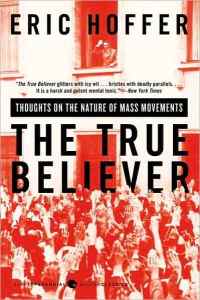 “The men of words are of diverse types. They can be priests, scribes, prophets, writers, artists, professors, students and intellectuals in general… Whatever the type, there is a deep-seated craving common to almost all men of words which determines their attitude to prevailing order. It is a craving for recognition; a craving for a clearly marked status above the common run of humanity.”
 Pursuit of Percipience