The Pessimistic Paradigm

2012_the_end_is_near_shirts-reeefe7b0f6f4426cb042ba4b241cb1f8_va6lr_512

I once had a four volume set of history books. All of the books were written by one British historian in the early 20th century. In the concluding paragraph of the last book, the author praised the future: the British empire was expanding, religion and superstition were fading, China would be taken in 100 years, wars were soon to disappear, and enlightenment was ready to shine forth over the whole world. And it’s interesting because on the page prior to this paragraph, the author described in detail the events which directly lead to WW1. The books were published shortly before that war started, so the author didn’t get a chance to take it all back. He had no idea.

The 20th century crushed a lot of people’s optimism. More war and destruction occurred in that century than ever before. And what replaced the optimism is a crippling pessimistic paradigm. Chicken Little has been busy. But it’s justified right? The world is getting worse and worse, is it not? The end must be near.

Imagine living in the days when the USA was being formed, or when the British empire was continually expanding. Imagine being a Christian directly involved in those times. Wouldn’t you have had a positive outlook on the future? You would not have been lamenting on the end times when you were currently helping to usher in the Golden Age, the Millennium. But look what’s happening now; the western world has turned from its faith, we have gay marriage, abortion, distrustful governments, electronic surveillance, terrorism, and relativistic morals. Surely the end is near.

Now that we’ve barely survived 1988, the Y2K bug, and the end of the Mayan calendar, perhaps it is a good time to take a closer look at this pessimistic paradigm. What shapes these paradigms? Why would people be positive in one generation, and then be negative in another. Obviously the events of the time determine people’s attitudes; if things are good, attitudes are good, and vice versa. This is obvious. But we forget.

As Christians we need to look beyond the ups and downs of human history, otherwise we will mistakenly determine our view of the future based on the spirit of the age. Our eschatology is not based on current events, it is based on what the Bible says.

And Jesus cried out and said, “Whoever believes in me, believes not in me but in him who sent me. And whoever sees me sees him who sent me. I have come into the world as light, so that whoever believes in me may not remain in darkness. If anyone hears my words and does not keep them, I do not judge him; for I did not come to judge the world but to save the world. The one who rejects me and does not receive my words has a judge; the word that I have spoken will judge him on the last day.”
~John 12:44-48

Jesus said He came to save the world. And to those who don’t believe, He said He would not judge them. This is interesting. It’s like walking into a room, and there are four people there you’ve never met, so you go and introduce yourself and shake hands with three of them. The fourth person you completely ignore and turn your back towards. This is what Jesus is doing to those who don’t believe. Those who don’t believe are excluded from the world, and Jesus came to save the world.

The Lord said to me, “You are my Son;
today I have begotten you.
Ask of me, and I will make the nations your heritage,
and the ends of the earth your possession.
You shall break them with a rod of iron
and dash them in pieces like a potter’s vessel.”
~Psalm 2:7b-9

And Jesus came and said to them, “All authority in heaven and on earth has been given to me. Go therefore and make disciples of all nations, baptizing them in the name of the Father and of the Son and of the Holy Spirit, teaching them to observe all that I have commanded you. And behold, I am with you always, to the end of the age.”
~Matthew 28:18-20

Did Jesus ask for all the nations? Clearly He did since in the Great Commission He commands us to go and disciple all the nations. So, God offers all the nations to Christ, Christ comes to save the world, and then He commands us to go and take all the nations for Him. I see a pattern developing here. Jesus actually intends to save the world, and use us to do it. But the pessimistic paradigm says, “No Lord. The world is just going to get worse and worse, and You’re just going to have to come and bail us out when things get too bad for us. Don’t You see the giants?!”

The word of God is our paradigm setter, not the world. Jesus has overcome the world.

“I have said these things to you in figures of speech. The hour is coming when I will no longer speak to you in figures of speech but will tell you plainly about the Father. In that day you will ask in my name, and I do not say to you that I will ask the Father on your behalf; for the Father himself loves you, because you have loved me and have believed that I came from God. I came from the Father and have come into the world, and now I am leaving the world and going to the Father.”

His disciples said, “Ah, now you are speaking plainly and not using figurative speech! Now we know that you know all things and do not need anyone to question you; this is why we believe that you came from God.” Jesus answered them, “Do you now believe? Behold, the hour is coming, indeed it has come, when you will be scattered, each to his own home, and will leave me alone. Yet I am not alone, for the Father is with me. I have said these things to you, that in me you may have peace. In the world you will have tribulation. But take heart; I have overcome the world.”
~John 16:25-33

Clean House

image

When I was a boy the condition of my bedroom was usually somewhere between death and destruction. It was messy. My mom often told me to clean it up, but since those warnings were never enforced, the state of my sleeping space never changed. My dad never looked into my bedroom, so all was well on that front.

One day, a day when my dad took a rare weekday off from work, I came home from school to have my mom bemoan to me that my dad was up in my room cleaning. This was bad news. In the boredom of his atypical day off, he wandered upstairs, saw my shame, and in an act of pure fury, proceeded to decontaminate it. I ran up to my room to find my dad on all fours haphazardly tossing whatever was on my closet floor over his back toward the waiting giant sized garbage bag, already half full with my precious valuables. The vacuum cleaner was busy devouring, and whatever was too small for my dad’s fingers was sucked up into its dark belly. All my things, which I had successfully categorized as junk and treasure, were seen as rubbish to my dad and were treated that way.

I learned a valuable lesson that day: if I don’t clean my own room, someone else will, and he’ll do it more harshly than I.

I’m reminded of this dark day of my childhood as I read about all the business and controversy over John MacArthur’s “Strange Fire” conference. MacArthur has basically taken the entire Charismatic Movement and thrown it into the hellfire. Very harsh. Too harsh. I disagree with MacArthur as I do believe that certain charismatic spiritual gifts are for believers today. But there is a line. Some charismatics cross that line, some charismatics don’t know where the line is. As a result there is a lot of stupid stuff that goes on in the Charismatic Movement which never gets addressed by Bible believing charismatics. Charismatics don’t clean their own house, and because of that, someone else is doing it for them, and he is harsh.

A “smalltime”Christian like me living on the backside of the desert in Cambodia writing a blog that nobody reads isn’t going to have much of an impact. But there are respected “continuationists” known to the public eye who have the ability to expose and depose the kooky charismaniacs. They need to speak up.

Facing Darker Days

image

One thing that western Christians need to remember is that the Christian Church does not revolve around the western world. And so, if it appears that the Church is “dying” in the west, that certainly does not mean it is dying worldwide. In fact, the Church is growing worldwide.

But is the Church really dying in the west? Or is this some kind of publicity stunt?

Something that is indeed happening in the west is that the secular and political realms are no longer paying homage to the Church. The “new atheism” we see these days does not just want to deny God’s existence, but it wants to tear down all Christian power in society. And this does seem to be happening; the Church has been and is losing power in the secular and political spheres.

But dying? Well I guess that depends on whether or not people are really getting saved and are joining churches. The numbers of those calling themselves Christian may be down, but how reliable are those numbers anyways? Ten years ago, if a surveyor went to any given house and asked what religion the home’s dweller belongs to, they’d probably get a response like, “Well, I grew up in a Catholic family, so I guess I’m Christian.” Yet the person hasn’t set foot in a church for 25 years. These days I think people are more inclined to be honest and say they are non-religious. They no longer feel the need to show some kind of respectful acknowledgment of religious tradition.

So perhaps the Church is not dying, but rather, with the loss of the Church’s political power, we are just seeing more honesty and realism. This is a good thing. The Church thrived in a hostile Roman Empire. No one dared to pretend to be Christian for personal gain. Nor did anyone sleepily pay tribute to the faith out of some obligation to tradition. Lines were clearly drawn, and no one could be a “casual believer”.

So, as the Church loses religious control over society, no one should lament that the end is near. The Church’s true influence will grow as its false religious and political clout dwindles.

photo credit: “A Letter From Pastor Mark”

Be Fruitful and Multiply

image

I don’t know what to believe about the global warming or climate change issue anymore because both sides of the contention say they’re 100% right and they cantankerously demonize each other.

But if we look to the issue from a Christian perspective, rather than a political one, we can see more clearly.

And God blessed them. And God said to them, “Be fruitful and multiply and fill the earth and subdue it and have dominion over the fish of the sea and over the birds of the heavens and over every living thing that moves on the earth.”
~Genesis 1:28

This verse is the first commission — our first duty as human beings in relation to this planet. God created the world, put our first parents into a garden surrounded by wilderness, and told them to expand the garden; take dominion.

What does it look like to take dominion?

Well obviously, since it was God who gave the order, we are to care for and nurture the earth. God cares for and nurtures His own, and so He clearly expects us to do the same. Notice how when you love and nurture plants, they grow and flourish. And when you love and care for a dog, that dog will be a loving gentle animal. It is our responsibility to enable lower life forms to reach their fullest potential. We do this through love and care. Unfortunately sin has totally screwed things up, but the original commission still stands. In fact, the newer ‘Great Commission’ given by Jesus, in Mark 16:14-18, empowers us to once again fulfill the first commission.

And I use the term ‘lower life forms’ designedly. I am not equal to a tree. I am greater than a tree. I was created in God’s image. The Giant Sequoia was not. And so while we care and nurture for the earth we are also commanded to be fruitful and multiply. That means having kids, building houses and roads, shaping the landscape, and developing new technologies. So, trees are going to be cut down, and animals are going to be relocated. This is okay when we do it in a caring, nurturing fashion.

When we obey God, act according to His character, and trust in His sovereignty, we don’t need to worry about the end of the world. Jesus came to save the world, not destroy it.

For I consider that the sufferings of this present time are not worthy to be compared with the glory which shall be revealed in us. For the earnest expectation of the creation eagerly waits for the revealing of the sons of God. For the creation was subjected to futility, not willingly, but because of Him who subjected it in hope; because the creation itself also will be delivered from the bondage of corruption into the glorious liberty of the children of God. For we know that the whole creation groans and labors with birth pangs together until now. Not only that, but we also who have the firstfruits of the Spirit, even we ourselves groan within ourselves, eagerly waiting for the adoption, the redemption of our body. For we were saved in this hope, but hope that is seen is not hope; for why does one still hope for what he sees? But if we hope for what we do not see, we eagerly wait for it with perseverance.
~Romans 8:18-25 (NKJV)

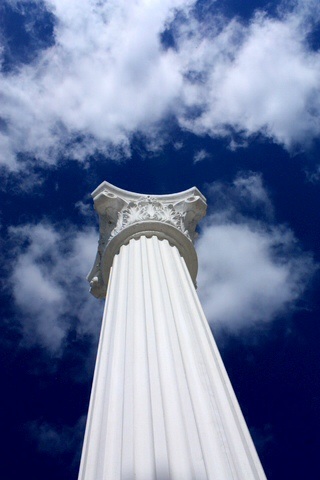
A Pedestal Too High

image

God speaks in a great language. His words are brimming and nothing in our experience can counter balance the heftiness of what He trumpets forth. Therefore, our crippling slant is to disbelieve what God has spoken about us, both in our being and doing. Our idea of Heaven and eternal life is as bland as contemporary church building architecture. We doubt hell, firstly because we are illicitly repulsed by it, secondly because we deem ourselves unworthy of it. So when God speaks, we are reluctant to apply His words to ourselves, and instead look to someone else preeminent and greater. We are content to consign God’s words to whomever is on a pedestal too high for our reach.

These days we are being conferred a shallow ‘playground righteousness’. The priests and priestesses of pop culture preach it well: “Now come on children. Let’s all be nice and get along. Everyone needs to feel good about themselves”. Now that’s fine for the playground if all there is is a playground, but for the graduated grown ups we have to go deeper than the sand; we must go down to the bedrock. A standard this deep looks to who God is, what He has set into place, and what He has done to cultivate it all. Here we have to listen carefully to God’s words, and bear the weight of those words, in our place and in our time.

I’ve heard it said that God doesn’t have a sense of humor. But of course He does. We have humor and we were created in His image. The Bible deals with a weighty matter and so we don’t see God cracking jokes in it. God takes us too seriously for that. In fact, it’s terrifying to think about how seriously God takes us. The bible describes God’s glory. The Hebrew word for glory (kabod) means weight or heaviness. That same glory passes on from God to us. We have an eternal worth that places us on a pedestal much higher than we think possible. And with that worth comes two options: turn to the Giver in faith and worship or spit on the Giver, the gift, and ourselves in disobedience.

When God created the universe (not multiverse) He set each and everything into its place. The sun goes here, the earth orbits the sun at this distance, the ocean stops at this line, each animal will reproduce its own kind, a man marries a woman. Order was brought from chaos. The book of Genesis describes the pre-created state as a dark empty wasteland. God then spoke His massive words, the sound of many waters, and everything that is came into being. Everything being done to the amplitude of never being undone. Everything with the worth that comes with eternity.

God doesn’t foresee anything, He ordains everything. And when the world fell into sin, God enacted the plan that shows us just how much worth the created world truly has. Jesus entered history and established a sovereignty that is beyond anything we could imagine. He became a man. He had to be a man in order to win the world back for men. He was born of a virgin. He had to be born of a virgin so as to not inherit the sinful nature. He lived a perfect life and satisfied God’s law. He died a bloody violent death and satisfied God’s wrath. He rose from the dead so that we who believe will do so also. He ascended into Heaven, the capital city, and established His kingdom. And He never gave up His manhood. A man, like us, sits and rules from a throne, a pedestal too high, but not too high.

**photo credit: http://www.stockfreeimages.com/10808584/Pedestal.html#_