“I don’t worry, if they have a problem with me, they will preach about me!”
That’s what a friend told me when describing the leadership at a bible college he was attending. He had discovered that when and if the leadership was unhappy with what he was doing, rather than confronting him directly, they would come at him indirectly through passive aggressive tactics. And a great way to destroy relationships is to act passive aggressively.
What is passive aggressiveness? It is simply an avoidance of direct confrontation due to cowardliness. If passive aggressiveness takes root in your group it becomes a poison killing the tree. You have to deal with it quickly.
I’ve been guilty of this behaviour myself in the past, but I’ve made a rule to avoid it. It takes time to recognize it in yourself, but gets easier to stop over time.
It is interesting how different social media platforms are used for different things. And this seems to support Marshall McLuhan’s famous statement: “The medium is the message.” As I have written about before, every medium is created for a specific purpose, and no matter how that medium is used, that specific purpose will manifest itself.
Take Facebook. Facebook is a platform created for you to present yourself, in the best possible way, to people who know you. Unlike Twitter, where you present your opinions (usually anonymously) to people who don’t know you, and unlike Instagram where you present images to people who don’t know you, your Facebook page is directed at people who know you and who you want to impress in a way which is positive to yourself.
But of course, your life is never perfect. Even when things are running quite well, your life most often falls short of your ideal expectations. But what do you present on Facebook? You present your life as though it always meets your ideal expectations. Therefore, your Facebook page is mostly deceptive.
And I often see this phenomenon with an organization’s Facebook page as well. Beware, when viewing a charity’s, or church’s, or missionary’s Facebook page. All may not be as it seems.
For example, I remember viewing a post by a missionary who had only recently begun working in Cambodia (which is where I live). The post consisted of several pictures of the missionary working with a western medical team. There was no written description of the post, only the photos. Anyone viewing the post would automatically assume that the medical team was there under the organization of the missionary, and sure enough, all the viewer comments proved that: “Great job!” … “You’re changing Cambodia!” … “Amazing team!”
Western medical teams don’t just partner with anybody. Those doctors are taking precious time off work and investing thousands of dollars into the trip. They don’t want their time wasted, and so will not partner with some new missionary who has only been on the field for a few months. So I was a little suspicious and I asked the missionary, “Was that your medical team?” No, of course it wasn’t. It was a team working with a well established organization, and the missionary had merely volunteered to help them for a day. But the Facebook photos made it look as though the missionary was running the show.
Maybe it’s not a big deal, and I just need to relax a bit. But this kind of stuff has always bothered me. I’ve seen it so many times that all the little examples build up and up into a big steaming pile of BS.
Perhaps I am just projecting here. How much of this am I guilty of myself? Would I even be able to see myself doing it?
As a Christian, one of the things I love most about Jesus is the fact that He is always sincere. Jesus will always present things as they truly are.
“Well here’s what’s in it for me, and here’s what’s in it for you. And here’s why the two of us together can further the enterprise and further what’s in it for you and further what’s in it for me.”
A good leader has a purpose great enough to include others besides himself. And in order to do that, he will find people who will benefit in their own personal lives from that larger purpose.
How do you replace a dictatorship? You create a republic.
A republic is much like a democracy in that the people rule. The people vote for what they want, and the majority wins. But, unlike a democracy, a republic will institute a constitution which will protect the rights of individuals regardless of what the majority might say. So, for example, if a constitution states that individuals are free to practice a particular religion, then even if the majority of citizens want that religion gone, the followers of it are still protected and free to practice.
A society of free individuals doesn’t just happen all on its own. Even if 99% of the people are in agreement, and want to live free lives, you still need to create a system of government which will protect that free society.
Dictatorships are much more natural than republics. If you make no effort to set up a republican system of government, and only hope for the best, you can be sure that one of two things will happen: 1) The society will collapse and dissipate; 2) A dictatorship will form. Anarchy never works.
The inner crisis of a disintegrating society is constituted by the fact that too many people inside this society are not told what to do… An unemployed man [or a hampered man] is a person who looks for orders and can’t find anybody to give him orders.*
I am a master electrician, although I haven’t worked in the trade for several years now. One thing about working in a trade is that once you’re past being a first year apprentice, your responsibilities on the job are no longer limited to the tool belt. You have to begin training the guys less experienced than you. And once you’re a journeyman, you’ll likely discover that most of your time on the job is teaching and supervising the apprentices.
The number one thing that will stop an apprentice from doing his work is a lack of knowing what to do. It won’t be laziness or apathy. He simply either was not given clear instructions, or he is too overwhelmed with the task before him. And once that happens, he’ll either stall out altogether or begin lying about what he’s actually doing.
I remember working for a company in which the boss (not a very good boss) left an apprentice to run a fairly large job. There were several different areas in one warehouse where electrical work needed to be done. The apprentice had the skills and knowledge to do every job, but he was struggling and falling behind. The boss sent me to help him get back on track. After walking through the job site with the apprentice to see where he was at, he said to me, “There is so much to do, and I just don’t know where to start.”
To remedy the situation, all I needed to do was lay out a systematic task list for him to follow: “Do that job first, because you’re going to need that powered up in order to do the next job. Do that other job next so that we can move this junk into that corner to have space to do the next thing. Next, do such and such…….” Once he knew what to do and in what order, he was back to working at his normal efficient speed.
Visionary leaders are rarely good at creating systematic task lists. Because their leadership style is so rooted in rhetoric, their connection with practical realities is severed. Visionary leaders are often throwing bricks in the air to build the second story of a building for which no proper foundation has been laid.
It is amazing what can be accomplished with mere rhetoric, and as I have written about before, visionary leaders are needed to inspire people at the beginning of a movement. But it is also amazing at how quickly the rhetoric can become completely meaningless. Some things sound good and wise when spoken, and they might even be true, but when you actually stop to ask what the thing said really means and how it applies to real day to day life, it proves to be completely worthless. And when I hear followers of visionary leaders parrot their slogans without thinking, like Winston in 1984 I get a little lonely and depressed.
When a visionary leader sees that his followers aren’t doing what he expects and hopes for them to do, he usually writes them off and says, “They just didn’t catch the vision.” And he might actually be correct, but does he ever ask why? Also, because his expectations are what they are, he usually is only followed by more future visionary leaders, which isn’t always desirable.
Mark Aspery ~ Blacksmith
A master knows that when his followers are not living up to his expectations, it’s usually because he hasn’t clearly defined what needs to be done at ground level. He hasn’t laid out the systematic task list. He assumes his followers are already passionate about the work and striving to be masters themselves (otherwise they wouldn’t be there), so he doesn’t waste time using himself as an example to inspire them to work harder or embrace the vision. He knows the passion will come from the work itself when the followers know what to do.
I am currently learning the skills and techniques of blacksmithing. Now, you can’t honestly call yourself a blacksmith until you’ve learned how to forge your own tongs. My first attempts at forging tongs resulted in embarrassing monstrosities which I kept hidden from my family so they wouldn’t laugh at me. I watched how-to videos and looked at pictures of completed tongs, but I could not get them right.
It wasn’t until I bought a book in which a master laid out the forging process, step by step, systematically. “Measure this much here … isolate this much material there … hammer down to half the bar’s thickness here …” Only then was I able to forge the tongs, and they turned out quite well.
When a visionary leader is most needed and effective, the movement which he is leading is in such a state of rapid growth that no one cares if there is any systematic structure at all. The movement is riding on a wave of excitement, and for the time, that is sufficient. But that wave is temporary. The master needs to step in and create some proper systematic structure.
Now, when I say “systematic structure” I am not talking about creating a bureaucracy. I am a borderline anarchist, and I hate all unnecessary rules. But, it is a false dichotomy to say that you can either have structure or freedom.
A master is a master precisely because he knows how to create freedom in the boundaries of structure.

 “I don’t worry, if they have a problem with me, they will preach about me!”
 It is interesting how different social media platforms are used for different things. And this seems to support Marshall McLuhan’s famous statement: “The medium is the message.” As I have
 “Well here’s what’s in it for me, and here’s what’s in it for you. And here’s why the two of us together can further the enterprise and further what’s in it for you and further what’s in it for me.”
 How do you replace a dictatorship? You create a republic.
 The inner crisis of a disintegrating society is constituted by the fact that too many people inside this society are not told what to do…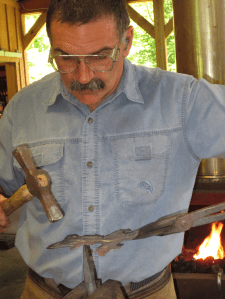
 It wasn’t until I bought a book in which a master laid out the forging process, step by step, systematically. “Measure this much here … isolate this much material there … hammer down to half the bar’s thickness here …” Only then was I able to forge the tongs, and they turned out quite well.
