In Relationship (Part Four)

covenant-quotes-001The Rarity of Covenants

“Asking for a definition of ‘covenant’ is something like asking for a definition of ‘mother'” 

~O. Palmer Robertson

Covenant is not a word to take lightly. If you say you are in covenant with someone, you’d be wise to know exactly what you are saying.

It’s easy to imagine a perfect circle. You can talk about it, analyze it, and theorize about it. But, until you actually draw it, it is just an idea. How many times do we come up with great ideas and then just stop there thinking our work is done. Ever been to a board meeting?

It is the same with the idea of covenant. It is easy to talk about, but extremely difficult to do. Covenants are rare.

So who actually enters into covenants? Families do: husbands and wives, parents and children, brothers and sisters, etc…

Members of organizations do not enter into covenants. They can say they do until their faces turn blue, but all you have to do is observe their actions for a little while and you’ll see that it is not true. Until one is willing to become family to another, he will be in a contractual relationship, or any other kind of relationship other than covenant.

Outside of covenant, before vision, before passion, and before loyalty, one is motivated by selfish desires. These selfish desires are not evil in and of themselves, they are naturally human. When these selfish desires lead one to do evil things, then they become harmful. But, how many people, who have done good and noble things, have not started out with selfish desires?

One member of an organization can say he’s in covenant with another. He can say that he values the success of the other over his own. He can hold himself as an example of what healthy covenants look like. He can do all that talking, but really he is putting his own selfish desires first. And that’s okay, as long as he is honest about it.

Charles Spurgeon said, “Sincerity makes the very least person to be of more value than the most talented hypocrite.” Even though one cannot be perfect in his covenant vows, if he is sincere in his actions he is a true covenant keeper. One who merely says he is in covenant, but does not act accordingly, is nothing more than a hypocrite.

This is especially true for leaders. Leaders have the “raw end of the deal” in the covenant. Like God, they have to be the better, stronger member of the covenant. Like God, it is up to them to define the terms of the covenant. Our covenants with each other must image God’s covenant with us.

“A covenant is a bond in blood sovereignly administered. When God enters into a covenantal relationship with men, he sovereignly institutes a life-and-death bond. A covenant is a bond in blood, or a bond of life and death, sovereignly administered.” (O. Palmer Robertson, The Christ of the Covenants [Phillipsburg, NJ: Presbyterian and Reformed Publishing, 1980], pg. 4)

Robertson gives three main attributes to a covenant:

  1. It is a bond — Covenant members are bound together in relationship and this bond is sealed with a binding oath (sometimes verbal, sometimes by symbolic action) by both parties. No oath = no bond = no covenant.
  2. It is a bond in blood — “By initiating covenants, God never enters into a casual or informal relationship with man. Instead, the implications of his bonds extend to the ultimate issues of life and death” (pg. 7-8). James B. Jordan has pointed out that the cutting in half of the animals in Genesis 15 was not so much God saying, “Let this happen to me if I don’t uphold my end of the covenant,” but rather, the cutting in half of the animals symbolized the death and resurrection of humanity. The new life was made possible by the covenant — just like with Adam, who “died”, was cut in two, and was resurrected to find a new covenant partner waiting for him: his wife. The same happened to Jesus. A covenant bond in blood is a familial bond — a bond where one dies to his old self and is reborn as something new.
  3. It is a bond in blood sovereignly administered — “Both biblical and extra-biblical evidence point to the unilateral form of covenant establishment. No such thing as bargaining, bartering, or contracting characterizes the divine covenants of Scripture. The sovereign Lord of heaven and earth dictates the terms of his covenant” (pg. 15). Covenants often involve a weaker party and a stronger party. Who determines the conditions of the covenant? The stronger party does. This is not a master/slave relationship — the stronger party wants the weaker to prosper and is willing to expend his own resources and time to make that happen.

As you can see above, covenants are no small matter, and to use the term lightly is foolish. If you can’t conform to the attributes of covenant listed above, then you can’t enter into covenant, and must not say that you have.

Sometimes it is best to enter into a different type of relationship. It all depends on what the circumstances are. The important thing is to make clear the kind of relationship all parties are entering into right from the start. This will prevent any confusion and contention between the parties in the future.

In Relationship ~ Part One; Part Two; Part Three; Part Five

In Relationship (Part Two)

www.cartoonstock.com-cartoonview.asp?catref=tcrn148Covenant Vs. Contract

“Here beyond men’s judgments all covenants were brittle.”

~Cormac McCarthy

Here’s Eugen Rosenstock-Huessy’s take on covenants and contracts:

“In a sale the two partners to the contract think of their own advantage. The whole content of a real marriage might be summed up in the statement that the two who are partners are each expected to care more for the other partner’s happiness than their own! No marriage could survive twenty-four hours if the couple should apply the rule of the law of contracts to their common life. While in business everybody minds his own business, in any dual [relationship] one partner minds the other partner’s business. A wife shall care for her man’s health more than for her own, and her husband shall care more for her comfort than for his own. To judge a marriage on the basis of the law of contract is an aberration from logical thinking.

“There is another side to the question. The duties derived from a contract are fixed in the beginning. The duties in any true [covenant] partnership are in permanent flux; they are the result not of the words spoken at the beginning but of the acts of the partners to the relationship while it lasts. These actions have a polarizing effect upon the two. The more you become my friend, the more I shall become yours. The mutual dependance is graded, and in the normal evolution of dual relations the two individuals are more and more encircled and transformed into the foci of one eclipse. Consequently, the action of each partner is shaping the form of the dual [relationship]. The polarity is established more definitely each time.

“Finally, the two are agents of a corporate body for which they stand, for from it they derive their activities. This becomes very clear in cases of absence or death of one partner. Then not only does one try to represent the other but also the general reaction of the partner who is left behind is that of stressing the point of view, the line of action, and the interest of the partner who has passed away. In a contract, however, I am free when the other party ceases to exist. It is a pluralistic or individualistic arrangement. Under the dual [arrangement] I am spell bound by the law of polarization. I remain the other half the more my second self is in decline or is prevented from taking his place.

“So we can say that a contract by which one party surrenders to the other would be void. Contracts are and must remain temporary arrangements for the individual forms of our existence, fleeting conglomerations for work and against nature outside. But in matrimony a wife surrenders her beauty and health to her husband for better, for worse. And the man surrenders his adventures, his infinite chances. How can such a perilous exposure of the whole being be treated as the result of a willful arrangement between two individuals? In a contract I try to get as much as possible, and to remain as unchanged as possible. In any partnership [covenant] I throw in my lot today without knowing where I shall be tomorrow.

~The Multiformity of Man (Norwich, VT: Argo Books [1936] 1973), pp. 54-55 (emphasis mine).

In my last post, I focused on loyalty mainly in the context of a contract. In a contract one will stay loyal so long as the other party is living up to their end of the deal. In a covenant, however, one will stay loyal so long as the other party is still alive, and perhaps even beyond that as Rosenstock-Huessy suggests above.

There are three main differences between covenants and contracts as Rosenstock-Huesy lists in the quote…

  1. A contract will have the duties listed for both parties at the beginning of the arrangement. Once those duties are fulfilled, the contract is over. The duties of a covenant are ever changing as the covenant is an unending agreement. What the parties agree to at the start of the covenant is to stay loyal to the covenant.
  2. Contracts must be temporary. Covenants must be permanent.
  3. In a contract my motives are purely selfish as I try to get as much as possible out of the deal, and I try to change as little as possible while satisfying my duties in the deal. In a covenant, I give up my selfish ambitions for the sake of the other party. I do change in the present and over time in order to meet the needs of my partner.

To stay loyal in a covenant is entirely up to me. I commit myself to my partner even if he/she cannot fulfill his/her duties.

Not all covenants are created equal. Not all relationships must be covenants. That isn’t even realistic. Sometimes a contract makes more sense. Don’t enter into a contract and then hold the other party to the conditions of a covenant. If you’re expected to fulfill certain duties in exchange for the resources of the other party, don’t get angry when, as you neglect your duties, you don’t receive their resources. Don’t enter into a covenant and treat it as a contract. If your wife breaks her leg and can’t cook for six weeks, that doesn’t mean you don’t have to fulfill your husbandly duties for those weeks.

I’ve noticed that when politics get ugly within an organization sometimes it is because there is not a clear definition of the relationship. One party thinks they’re in a covenant, while the other thinks they’re in a contract. Or, they both agree what kind of relationship they’re in, but the definitions of contract and covenant are not clearly known by one or both parties.

I’ve heard before that the difference between a contract and covenant is that a contract is 50/50, while a covenant is 100/100. But actually, a contract is 100/100 too. The difference is what the 100 refers to and for how long.

Enter a contract when…

  • …you want to pursue your own agenda and you need someone else’s resources to do so.
  • …you don’t want to be attached to the other party indefinitely.
  • …you want to be free from your obligation if the other party does not fulfill theirs.

Enter a covenant when…

  • …you want the other party to prosper over and above yourself.
  • …you want a life long relationship, for better or for worse.
  • …you’re willing to uphold the covenant, and its purpose, even when your partner cannot do the same.

Obviously, contracts and covenants are quite different, and you don’t want to enter into one when you should be entering into the other. Know what you want first and choose wisely.

In Relationship ~ Part One

In Relationship ~ Part Three

In Relationship (Part One)

www.cartoonstock.com-cartoonview.asp?catref=llan448Staying Loyal

“If something cannot go on forever, it will stop” ~Herbert Stein’s law

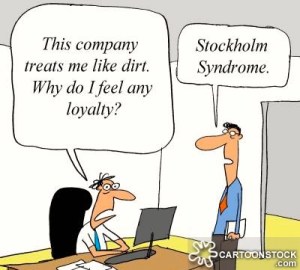
If you’re going to stay loyal to an organization you really have to love that organization. You have to love its philosophy, its theology, vision, structure of government, mandate, etc… If you don’t love it, you can not last.

John Boyd wrote that, as individuals, our basic goal is “to improve our capacity for independent action”*. In order to fulfill this goal we can not work alone. We have to cooperate with others. Boyd continues…

“The degree to which we cooperate, or compete, with others is driven by the need to satisfy this basic goal. If we believe that it is not possible to satisfy it alone, without help from others, history shows us that we will agree to constraints upon our independent action—in order to collectively pool skills and talents in the form of nations, corporations, labor unions, mafias, etc.—so that obstacles standing in the way of the basic goal can either be removed or overcome. On the otherhand, if the group cannot or does not attempt to overcome obstacles deemed important to many (or possibly any) of its individual members, the group must risk losing these alienated members. Under these circumstances, the alienated members may dissolve their relationship and remain independent, form a group of their own, or join another collective body in order to improve their capacity for independent action.”

Taking that into account, we can also say that if one is going to stay loyal, one has to feel as though he is able to pursue his own individual goals while belonging to the organization. If he feels he cannot do that, he will either leave or stay as an unhappy member of the group.

Being loyal does not just mean staying with the group. Being loyal means contending for the group in its mission and mandate. If one does not love, or fit in with, the mission or the mandate, then one cannot contend for the organization.

Sometimes, if the leadership has forgotten the original mission, a disgruntled member of the group (perhaps a “Man of Words“) may speak out to remind them. That person may seem like a rebel, but really he is contending for the organization. An organization, once it has initially fulfilled its mission, may turn to other ventures in order to survive. The original, fanatical, leadership may consider the survival (the continued existence) of the organization to be more important than its original mission.** This change in venue may restrict the individual members from achieving their independent goals which, up till that point, lined up with the organization’s original mission.

Other times, however, the members of the group, in their foolhardy zeal to just do something, may have misread the intentions of the organization right from the start. Sometimes the leadership does not make its intentions clear at the beginning because, they too, are looking to pursue an individual goal. If an organization’s leaders can use the members to achieve what they as leaders want, once that achievement is accomplished, they may have no more use for those members, and the members will find that their opportunity for accomplishing their own independent goals has evaporated.

The ideal situation then is when “skills and talents are pooled, (and) the removal or overcoming of obstacles represents an improved capacity for independent action for all.”

Loyalty happens…

  • …when the intentions (re: mission, mandate, theology, system of government, etc…) of both the leadership and the members are clearly stated and understood right from the beginning.
  • …when both the leaders and the members feel that they can successfully pursue their own independent goals.
  • …when, as things change over time, a clear and honest line of communication is kept between the leadership and its members.
  • …when the survival of the organization does not outweigh the mission and the mandate of the organization.

*Destruction and Creation by John R. Boyd

**You know this is happening when the leadership starts to lie about how successful the organization is.

In Relationship ~ Part Two

In Relationship ~ Part Three


Men of Words

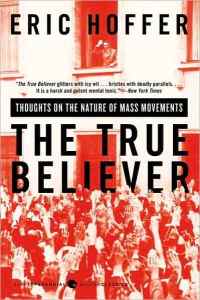
tb 001“The men of words are of diverse types. They can be priests, scribes, prophets, writers, artists, professors, students and intellectuals in general… Whatever the type, there is a deep-seated craving common to almost all men of words which determines their attitude to prevailing order. It is a craving for recognition; a craving for a clearly marked status above the common run of humanity.”
~Eric Hoffer

“Mass movements do not usually rise until the prevailing order has been discredited. The discrediting is not an automatic result of the blunders and abuses of those in power, but the deliberate work of men of words with a grievance. Where the articulate are absent or without a grievance, the prevailing dispensation, though incompetent and corrupt, may continue in power until it falls and crumbles of itself.” (“The True Believer”, by Eric Hoffer, HarperCollins Publishing, New York, pg. 130)

Here Hoffer is describing the climate of a society before a mass movement begins, but I think we can also apply this statement to a mass movement that has passed its “dynamic stage” but the original fanatical leadership has not yet stepped down, and is in fact doing damage to the movement. The men of words can rise up again at this stage in the movement, inspiring the masses to change the leadership to a practical man of action.

“The preliminary work of undermining existing institutions, of familiarizing the masses with the idea of change, and of creating receptivity to a new faith, can be done only by men who are, first and foremost, talkers or writers and are recognized as such by all. As long as the existing order functions in a more or less orderly fashion, the masses remain basically conservative. They can think of reform but not of total innovation. The fanatical extremist, no matter how eloquent, strikes them as dangerous, traitorous, or even insane. They will not listen to him…

“Things are different in the case of the typical man of words. The masses listen to him because they know that his words, however urgent, cannot have immediate results. The authorities either ignore him or use mild methods to muzzle him. Thus imperceptibly the man of words undermines established institutions, discredits those in power, weakens prevailing beliefs and loyalties, and sets the stage for the rise of a mass movement.” (pp. 130-131)

Again, even after the movement has begun and has been running for several years, the men of words can do the same thing to the established authority of whomever started the movement. As shown in my last article about Hoffer’s book, the most important people to the leadership of a mass movement are the lieutenants. It is these lieutenants that can and should be swayed by the man of words if one wants to see a change in leadership.

What is a man of words like?

“There is apparently an irremediable insecurity at the core of every intellectual (man of words), be he noncreative or creative. Even the most gifted and prolific seem to live a  life of eternal self-doubting and have to prove their worth anew each day.

“‘…he has much more vanity than ambition; and he prefers consideration to obedience, and the appearance of power to power itself. Consult him constantly, and then do just as you please. He will take more notice of your deference to him than of your actions.’ (Hoffer quotes Alexis de Tocqueville, Recollections [New York: Macmillan Company, 1896], pg. 331.)” (pp. 132-133)

The man of words is fickle, pledging loyalty to whomever will give him an ear.

“However much the protesting man of words sees himself as the champion of the downtrodden and injured, the grievance which animates him is, with very few exceptions, private and personal. His pity is usually hatched out of his hatred for the powers that be.” However, “When his superior status is suitably acknowledged by those in power, the man of words usually finds all kinds of lofty reasons for siding with the strong against the weak.” (pp. 133-134)

“It is easy to see how the faultfinding man of words, by persistent ridicule and denunciation, shakes prevailing beliefs and loyalties, and familiarizes the masses with the idea of change. What is not so obvious is the process by which the discrediting of existing beliefs and institutions makes possible the rise of a new fanatic faith.

“The genuine man of words himself can get along without faith in absolutes. He values the search for truth as much as truth itself. He delights in the clash of thought and in the give-and-take of controversy.” (pp. 139-140)

But, the future that the man of words hopes for, a society of free thinking people, is usually not what comes. Rather, what is created is a “corporate society that cherishes utmost unity and blind faith.” (pg. 139)

“The tragic figures in the history of a mass movement are often the intellectual precursors (the men of words) who live long enough to see the downfall of the old order by the action of the masses.” (pg. 141)

A Conflict of Visions (Book Overview)

a_conflict_of_visions

“A Conflict of Visions” was written by economist/philosopher Thomas Sowell.

Here is the description from Amazon:

In this classic work, Thomas Sowell analyzes the two competing visions that shape our debates about the nature of reason, justice, equality, and power: the “constrained” vision, which sees human nature as unchanging and selfish, and the “unconstrained” vision, in which human nature is malleable and perfectible. He describes how these two radically opposed views have manifested themselves in the political controversies of the past two centuries, including such contemporary issues as welfare reform, social justice, and crime.

Here are some of my notes on the book:

Part I ~ Patterns

  • Our visions shape our theories — visions can not be tested, they are presuppositional, and they tend to be simple.
  • Our theories can be tested by facts. Facts can not prove theories, but facts do cause us to disregard bad theories.

The Constrained Vision

  • There are realities about this world that can not be changed. Therefore, rather than wasting time and effort trying to change them, one needs to learn to work within them.
  • One needs to learn to make the most of the possibilities available within the constraints of reality.
  • The constrained vision deals in trade-offs — choosing the better option and accepting that there are no ideal options.
  • When there are people suffering in this world through poverty, war, etc., some would want you to continuously feel bad (or guilty) for those who are suffering — your guilt = their suffering. Thus you will be motivated to help them. The constrained vision says that it is useless for you to continuously “feel” their suffering (and it is unnatural as well) — better to embrace your natural inclination for self-improvement.
  • Facts = Reality
  • Virtue = the best possible trade-off/prudence
  • Your desire for self-improvement forces you to work with and for the benefit of others. Thus, as people work to improve their own lives, they end up working to improve the lives of others — the world becomes better for all people. This improvement is unintentional, but it does happen, and it happens without a human power to plan it.
  • The leaders need to be educated “down to” the level of the masses.
  • Self-interest is a better motivator than guilt and it has better results for the suffering too.
  • People’s selfish desire for self-improvement motivates them to get the job done — this is better than depending a person’s disposition for their motivation.
  • “Do right because it is in your best interest” rather than “Do right because you know it’s the right thing to do.”

The Unconstrained Vision

  • We can change the world for the better.
  • We can change human nature if only: The right people were in charge; The right institutions were created; People were educated properly; etc…
  • Whereas the Constrained Vision says that bad institutions are a result of flawed humanity, the Unconstrained Vision says that bad institutions are the cause of flawed humanity.
  • We can feel other people’s needs as well as our own (if not better).
  • Self-interest is the negative result of bad institutions.
  • There are individuals who are intelligent enough to know how to fix all our problems, and these individuals should be given the power to do so, even if it causes suffering and limited freedom for the masses.
  • The masses need to be educated “up to” the level of the leaders.
  • Idealism = Reality
  • Virtue = Final solutions to problems
  • An institution’s intentional benefits to society are the greatest virtue. Unintentional benefits to society are not acknowledged. We can always know what is good/bad for society and why that is so, and plan accordingly.

Note: The way in which Sowell uses the word vision, the word world-view could be used as well.

Note: Constrained Vision does not necessarily equal Conservative while Unconstrained Vision equals Liberal (although that seems to be the norm). One can be a Constrained Conservative or an Unconstrained. For example: a Constrained Conservative would not want to send troops into Iraq as the cost of human life and military resources would be too great for an unpredictable outcome, whereas an Unconstrained Conservative would want to send in troops believing that they could create a successful democracy in Iraq. Or, a Constrained Liberal, although wanting a large government, wants governmental power to be spread out through several government departments, whereas an Unconstrained Liberal wants an “all-knowing” leader to have sovereign control over the decisions affecting society.

Note: Nobody holds 100% to one vision and 0% to the other. There are various degrees between of course. Sowell himself clearly holds to the Constrained Vision.

Knowledge ~ The Constrained Vision

  • No one person, or small group of individuals, knows enough to make good decisions for society (or even for himself).
  • The collective knowledge of the culture and its history is best for making decisions.
  • Even if we don’t know why what is best is best, we can trust the experience of history and can still benefit.
  • We should be slow to criticize the cultural norms of our society as these norms are built on the experience of millions of people both in the past and in the present.
  • Defects in society are not in themselves reason for radical change — rational small adjustments over time will give us the best possible options for the future.

Knowledge ~ The Unconstrained Vision

  • Nothing is sacred just because its old.
  • Wisdom of the ages = ignorance of today
  • Old = untrustworthy
  • Reason and meditation is better than partially explained (or unexplained) historical collective wisdom.
  • People who hold to old traditional views need to be enlightened before any progress can be made in society.
  • If history’s collective wisdom is represented by a-x (x being today’s constrained generation; y being today’s unconstrained generation), x is ignorant because a-w is obsolete and irrelevant now.
  • Whereas with the Constrained Vision a-w is so ingrained into our minds we can’t always explain the wisdom or benefits of it, the Unconstrained Vision only considers y as having the proper knowledge to advance society.
  • y is the wisdom in the hands of a select few who must then lead society.

Knowledge ~ Reason and Rationality

  • There are two “kinds” of reason: A) cause and effect; scientific method — B) to justify one’s actions.
  • In the Constrained Vision A and B are far apart, whereas in the Unconstrained Vision, A and B are closer together.
  • Constrained Vision: We don’t always know why things are the way they are.
  • Unconstrained Vision: We know why things are the way they are and we should be able to specify those reasons.
  • Religion: God is unconstrained while humans are constrained.
  • Law: With the Constrained Vision laws are something passed down to us by previous generations, and with the Unconstrained Vision laws are seen as something to be invented afresh today.
  • Sowell quotes Hayek: “The most dangerous state in the growth of civilization may well be that in which man has come to regard all these (old) beliefs as superstitions and refuses to accept or to submit to anything which he does not rationally understand. The rationalist whose reason is not sufficient to teach him those limitations of the power of conscious reason, and who despises all the institutions and customs which have not been consciously designed, would thus become the destroyer of the civilization built upon them.” (F.A. Hayek, The Counter Revolution of Science: Studies on the Abuses of Reason [Indianapolis: Liberty Press, 1979], pp. 162-163.)

Knowledge ~ Social Policy

  • The Unconstrained Vision wishes to see more economic and social equality among the masses — even if the decision making process to produce that equality is itself unequal –> equality imposed by an unequal power structure.
  • The Constrained Vision is not so much concerned with societal inequality as it is with inequality in the power structure.
  • In regards to social planning, with the Constrained Vision, each individual sticks to what he is specialized in and allows the systemic process to determine social outcomes. When each person does his/her part (fulfills his/her role) the systemic process functions normally. If you’re a physicist, stick to physics. If you’re a carpenter, stick to carpentry. You will only corrupt the system if you get involved in areas in which you have no knowledge or experience.
  • In regards to social planning with the Unconstrained Vision, each person needs to act in ways which they feel will promote equality in all of society. If you’re a business owner, hire people who you feel are at a disadvantage. If you’re a teacher, bring up social issues in your class which you feel the students should be aware of, such as gender equality.
  • The Constrained Vision sees individuals, for example businessmen, as being unqualified to make decisions for the greater society. The businessman can best serve society by doing what he knows how to do for his own self-interest — the benefits to society will come through the systemic process. If he tries to “fix” society intentionally, he will only do damage.

Knowledge ~ Sincerity Vs. Fidelity

  • Sincerity is imperative in the Unconstrained Vision. Each individual must be sincere and sincerity = being right.
  • With the Constrained Vision, sincerity = believing what you’re doing is right. But you may not be right. (Hitler was very sincere.) With the Constrained Vision, fidelity is a virtue –> faithful commitment to one’s role in life within the sphere of one’s competence. Sincerity is not that important.
  • For example: A constrained judge is loyal to the existing law; an unconstrained judge sincerely wants to change the law for the “greater good”.
  • Because sincerity is held at such a high regard in the Unconstrained Vision, the sincerity of one who holds to the Constrained Vision is looked on suspiciously — “What are his real motives?” Whereas those who hold to the Constrained Vision are much less concerned with sincerity as the societal system is so complex that even the most sincere person can still be mistaken.
  • “The first thing a man will do for his ideals is lie.” (Joseph A. Schumpeter, History of Economic Analysis [New York: Oxford University Press, 1954], pg. 96).

Knowledge ~ Youth and Age

  • Constrained: Wisdom is of the older. Prudence is of the wise.
  • Unconstrained: Youth are unstained by the past prejudices and therefore are more capable of embracing new and better ideas.

Social Processes

  • Order and design –> some processes are more ordered than others –> Like a wild growing of vegetation versus a planned garden.

Social Processes ~ The Constrained Vision

  • There is no designer, but yet the processes work.
  • Like language — A language can be created, but a created language will be no where near the complexity of an evolved language.
  • Dictionaries of “true” languages are written after the language has developed. While dictionaries of made-up languages are written before.
  • Language does change over time, but this is not done quickly or under the design of a “master planner”.
  • Individuals plan for themselves, but no authority plans for the masses.
  • Social processes, then, evolve on their own over time as millions of individuals make decisions throughout their lives and throughout  the generations.

Social Processes ~ The Unconstrained Vision

  • We can design, like an engineer, social processes which will work.
  • One starts engineering the social processes by figuring out society’s needs, then one assembles all the relative facts, and then solutions can be found and planned for.
  • We can predict the outcome of our plans like in science.
  • Properly educated people can/must make these plans.

Social Processes ~ Time

  • With the Unconstrained Vision, the social decisions (concerning liberty, government, law, etc.) of the past generations limit the benefits of the present and the future, therefore flexibility is most desired in the ability to change past commitments as new information becomes available. Each current social decision to be made must be approached as if for the first time. Past decisions/commitments for the same issue need not be considered as the information they had in the past was less than what exists today.
  • The Constrained Vision asks these questions: Just how much more information (knowledge, rationality) do we really have now than before? What is the cost to society when making “moment to moment” decisions?
  • Where the belief is held that knowledge increases greatly over time, people tend to want to change things more quickly. In contrast, where the belief is held that knowledge increases slowly over time (or not at all in regards to rationality or wisdom — a growth in scientific or technological knowledge does not mean a society is growing wiser) the people tend to resist change and stay committed to past decisions.
  • Elsewhere, Sowell give these three questions to ask when about to make a change: Compared to what? At what cost? What is your hard evidence? He says that most liberal arguments are dispelled by these three questions.
  • Constrained Vision: Society runs better when there are rules applied to everyone, which everyone knows, and were decided on over time.
  • Unconstrained Vision: Rules are decided upon as relative issues come up based on their merit right now.
  • Constrained Vision: Right or wrong/for better or for worse, I am a citizen of my country first.
  • Unconstrained Vision: I am a citizen of the world first, country second.
  • Constrained Vision: A nation evolves slowly over time — to take it apart destroys it — it can not be put back together again in a different way.
  • Unconstrained Vision: We can build a nation how we want — take apart the building blocks — and put them together another way.
  • From the book: With the Constrained Vision, “…the incremental gain in individual knowledge by avoiding commitments is trivial, compared to the accumulated experience of the society.” (pg. 82)

** I’m not going to finish overviewing this book. It’s too much. Just buy it and read it yourself.**

***