In Relationship (Part Six)

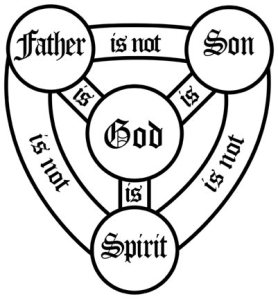
trinity1Trinity Vs. Triangulation 

“A real Christian is a person who can give his pet parrot to the town gossip.”

~Billy Graham

Do you have any relationships which are entirely based on gossip?

I remember a few years back starting a new job at a fairly large construction company. I was already a fully licensed electrician but the owners had me work along side some long-time employees so that I could learn the ropes as to how things ran at this particular company.

I was surprised at the amount of gossip and dissension I heard from these guys. They would talk bad about each other and talk even worse about the owners. When I was with employees A and B, they would bash employee C. When I was with B and C, they would bash A. This would go on day after day, the same conversations over and over again.

After a time I was given my own work truck, my own helper, and my own jobs — I no longer had to work with these guys. Five years later we hit a slow period and the owners put different crews together on the same jobs to keep everyone working. Once again I was working along side these gossipers. It was a shock to me to hear them still having the same conversations, still bashing each other behind their backs, still with the same complaints about the owners. After five years nothing had changed! Actually there was one noticeable change — all of them had more grey hair. I remember thinking, “These guys are stuck in kind of hell”.

Begotten from the Father came the Son, and a relationship exists between the two. That relationship is the third person of the trinity: the Holy Spirit. (See Jonathan Edward’s essay on the trinity.)

Within the trinity, all three members (Father, Son, and Holy Spirit) are giving themselves to the other members. The Father does everything He does for the Son. The Son does everything He does for the Father. The Holy Spirit does everything He does for the Father and the son. This is a covenant relationship, the first covenant relationship. All true covenant relationships are based on the trinity.

But what would happen if the Father and the Son got together to attack the Holy Spirit? Or the Spirit and the Son to attack the Father? The God of the bible would be no more, and all that exists would be no more. God’s own relationship within Himself is essential for all life.

When I and another have a common enemy, even if he and I would not ordinarily form a relationship, we will form a relationship for the purposes of attacking our common enemy. This is called triangulation.

The best and most common example of triangulation I can give is the one of gossip above. Two people, whose relationship is based solely on the attack of a third person, joining forces for only as long as the third person is a threat. Once the third person is gone, the relationship is over. This is anti-relationship.

The problem with gossip is that it is so compelling. What better way to boost yourself up than by bringing another down, especially when the other is not even able to defend themself at that.

That life only leads to misery. Better to give yourself in a covenant and live than die in the loneliness of triangulation.

In Relationship ~ Part One; Two; Three; Four; Five

Use a Transformer

electricity-transformer-300x235If you live in the west and travel to the east, you have to be careful with the electrical devices you bring.
In the west, the voltage at an outlet is 120 volts, whereas in the east it will be 220 volts. If you plug your western electric razor in without an adaptor, you will fry your razor.

I like to use this illustration when teaching hermeneutics. You have to be careful when taking texts written thousands of years ago and applying them to today’s world.

All the so called “end-times” texts come to mind. When someone writes “the end of all things is at hand” two thousand years ago (1 Peter 4:7*), you don’t read that in 2015 and go out into the streets shouting the end is near.

You have to figure out what the original author meant by his words. What was coming to an end for him two thousand years ago? Then, once you’ve figured out his meaning, you can then apply the principles of what he was saying to your own time.

Sometimes you can take texts and plug them right in without the transformer (like with the wisdom literature), but the bible itself will teach you when and when not to do that.

And… just plain common sense.

*Also see: 1 Corinthians 10:11; James 5:7-9; 1 John 2:18; Hebrews 10:25; Jude 17-18.

A Conflict of Visions (Book Overview)

a_conflict_of_visions

“A Conflict of Visions” was written by economist/philosopher Thomas Sowell.

Here is the description from Amazon:

In this classic work, Thomas Sowell analyzes the two competing visions that shape our debates about the nature of reason, justice, equality, and power: the “constrained” vision, which sees human nature as unchanging and selfish, and the “unconstrained” vision, in which human nature is malleable and perfectible. He describes how these two radically opposed views have manifested themselves in the political controversies of the past two centuries, including such contemporary issues as welfare reform, social justice, and crime.

Here are some of my notes on the book:

Part I ~ Patterns

  • Our visions shape our theories — visions can not be tested, they are presuppositional, and they tend to be simple.
  • Our theories can be tested by facts. Facts can not prove theories, but facts do cause us to disregard bad theories.

The Constrained Vision

  • There are realities about this world that can not be changed. Therefore, rather than wasting time and effort trying to change them, one needs to learn to work within them.
  • One needs to learn to make the most of the possibilities available within the constraints of reality.
  • The constrained vision deals in trade-offs — choosing the better option and accepting that there are no ideal options.
  • When there are people suffering in this world through poverty, war, etc., some would want you to continuously feel bad (or guilty) for those who are suffering — your guilt = their suffering. Thus you will be motivated to help them. The constrained vision says that it is useless for you to continuously “feel” their suffering (and it is unnatural as well) — better to embrace your natural inclination for self-improvement.
  • Facts = Reality
  • Virtue = the best possible trade-off/prudence
  • Your desire for self-improvement forces you to work with and for the benefit of others. Thus, as people work to improve their own lives, they end up working to improve the lives of others — the world becomes better for all people. This improvement is unintentional, but it does happen, and it happens without a human power to plan it.
  • The leaders need to be educated “down to” the level of the masses.
  • Self-interest is a better motivator than guilt and it has better results for the suffering too.
  • People’s selfish desire for self-improvement motivates them to get the job done — this is better than depending a person’s disposition for their motivation.
  • “Do right because it is in your best interest” rather than “Do right because you know it’s the right thing to do.”

The Unconstrained Vision

  • We can change the world for the better.
  • We can change human nature if only: The right people were in charge; The right institutions were created; People were educated properly; etc…
  • Whereas the Constrained Vision says that bad institutions are a result of flawed humanity, the Unconstrained Vision says that bad institutions are the cause of flawed humanity.
  • We can feel other people’s needs as well as our own (if not better).
  • Self-interest is the negative result of bad institutions.
  • There are individuals who are intelligent enough to know how to fix all our problems, and these individuals should be given the power to do so, even if it causes suffering and limited freedom for the masses.
  • The masses need to be educated “up to” the level of the leaders.
  • Idealism = Reality
  • Virtue = Final solutions to problems
  • An institution’s intentional benefits to society are the greatest virtue. Unintentional benefits to society are not acknowledged. We can always know what is good/bad for society and why that is so, and plan accordingly.

Note: The way in which Sowell uses the word vision, the word world-view could be used as well.

Note: Constrained Vision does not necessarily equal Conservative while Unconstrained Vision equals Liberal (although that seems to be the norm). One can be a Constrained Conservative or an Unconstrained. For example: a Constrained Conservative would not want to send troops into Iraq as the cost of human life and military resources would be too great for an unpredictable outcome, whereas an Unconstrained Conservative would want to send in troops believing that they could create a successful democracy in Iraq. Or, a Constrained Liberal, although wanting a large government, wants governmental power to be spread out through several government departments, whereas an Unconstrained Liberal wants an “all-knowing” leader to have sovereign control over the decisions affecting society.

Note: Nobody holds 100% to one vision and 0% to the other. There are various degrees between of course. Sowell himself clearly holds to the Constrained Vision.

Knowledge ~ The Constrained Vision

  • No one person, or small group of individuals, knows enough to make good decisions for society (or even for himself).
  • The collective knowledge of the culture and its history is best for making decisions.
  • Even if we don’t know why what is best is best, we can trust the experience of history and can still benefit.
  • We should be slow to criticize the cultural norms of our society as these norms are built on the experience of millions of people both in the past and in the present.
  • Defects in society are not in themselves reason for radical change — rational small adjustments over time will give us the best possible options for the future.

Knowledge ~ The Unconstrained Vision

  • Nothing is sacred just because its old.
  • Wisdom of the ages = ignorance of today
  • Old = untrustworthy
  • Reason and meditation is better than partially explained (or unexplained) historical collective wisdom.
  • People who hold to old traditional views need to be enlightened before any progress can be made in society.
  • If history’s collective wisdom is represented by a-x (x being today’s constrained generation; y being today’s unconstrained generation), x is ignorant because a-w is obsolete and irrelevant now.
  • Whereas with the Constrained Vision a-w is so ingrained into our minds we can’t always explain the wisdom or benefits of it, the Unconstrained Vision only considers y as having the proper knowledge to advance society.
  • y is the wisdom in the hands of a select few who must then lead society.

Knowledge ~ Reason and Rationality

  • There are two “kinds” of reason: A) cause and effect; scientific method — B) to justify one’s actions.
  • In the Constrained Vision A and B are far apart, whereas in the Unconstrained Vision, A and B are closer together.
  • Constrained Vision: We don’t always know why things are the way they are.
  • Unconstrained Vision: We know why things are the way they are and we should be able to specify those reasons.
  • Religion: God is unconstrained while humans are constrained.
  • Law: With the Constrained Vision laws are something passed down to us by previous generations, and with the Unconstrained Vision laws are seen as something to be invented afresh today.
  • Sowell quotes Hayek: “The most dangerous state in the growth of civilization may well be that in which man has come to regard all these (old) beliefs as superstitions and refuses to accept or to submit to anything which he does not rationally understand. The rationalist whose reason is not sufficient to teach him those limitations of the power of conscious reason, and who despises all the institutions and customs which have not been consciously designed, would thus become the destroyer of the civilization built upon them.” (F.A. Hayek, The Counter Revolution of Science: Studies on the Abuses of Reason [Indianapolis: Liberty Press, 1979], pp. 162-163.)

Knowledge ~ Social Policy

  • The Unconstrained Vision wishes to see more economic and social equality among the masses — even if the decision making process to produce that equality is itself unequal –> equality imposed by an unequal power structure.
  • The Constrained Vision is not so much concerned with societal inequality as it is with inequality in the power structure.
  • In regards to social planning, with the Constrained Vision, each individual sticks to what he is specialized in and allows the systemic process to determine social outcomes. When each person does his/her part (fulfills his/her role) the systemic process functions normally. If you’re a physicist, stick to physics. If you’re a carpenter, stick to carpentry. You will only corrupt the system if you get involved in areas in which you have no knowledge or experience.
  • In regards to social planning with the Unconstrained Vision, each person needs to act in ways which they feel will promote equality in all of society. If you’re a business owner, hire people who you feel are at a disadvantage. If you’re a teacher, bring up social issues in your class which you feel the students should be aware of, such as gender equality.
  • The Constrained Vision sees individuals, for example businessmen, as being unqualified to make decisions for the greater society. The businessman can best serve society by doing what he knows how to do for his own self-interest — the benefits to society will come through the systemic process. If he tries to “fix” society intentionally, he will only do damage.

Knowledge ~ Sincerity Vs. Fidelity

  • Sincerity is imperative in the Unconstrained Vision. Each individual must be sincere and sincerity = being right.
  • With the Constrained Vision, sincerity = believing what you’re doing is right. But you may not be right. (Hitler was very sincere.) With the Constrained Vision, fidelity is a virtue –> faithful commitment to one’s role in life within the sphere of one’s competence. Sincerity is not that important.
  • For example: A constrained judge is loyal to the existing law; an unconstrained judge sincerely wants to change the law for the “greater good”.
  • Because sincerity is held at such a high regard in the Unconstrained Vision, the sincerity of one who holds to the Constrained Vision is looked on suspiciously — “What are his real motives?” Whereas those who hold to the Constrained Vision are much less concerned with sincerity as the societal system is so complex that even the most sincere person can still be mistaken.
  • “The first thing a man will do for his ideals is lie.” (Joseph A. Schumpeter, History of Economic Analysis [New York: Oxford University Press, 1954], pg. 96).

Knowledge ~ Youth and Age

  • Constrained: Wisdom is of the older. Prudence is of the wise.
  • Unconstrained: Youth are unstained by the past prejudices and therefore are more capable of embracing new and better ideas.

Social Processes

  • Order and design –> some processes are more ordered than others –> Like a wild growing of vegetation versus a planned garden.

Social Processes ~ The Constrained Vision

  • There is no designer, but yet the processes work.
  • Like language — A language can be created, but a created language will be no where near the complexity of an evolved language.
  • Dictionaries of “true” languages are written after the language has developed. While dictionaries of made-up languages are written before.
  • Language does change over time, but this is not done quickly or under the design of a “master planner”.
  • Individuals plan for themselves, but no authority plans for the masses.
  • Social processes, then, evolve on their own over time as millions of individuals make decisions throughout their lives and throughout  the generations.

Social Processes ~ The Unconstrained Vision

  • We can design, like an engineer, social processes which will work.
  • One starts engineering the social processes by figuring out society’s needs, then one assembles all the relative facts, and then solutions can be found and planned for.
  • We can predict the outcome of our plans like in science.
  • Properly educated people can/must make these plans.

Social Processes ~ Time

  • With the Unconstrained Vision, the social decisions (concerning liberty, government, law, etc.) of the past generations limit the benefits of the present and the future, therefore flexibility is most desired in the ability to change past commitments as new information becomes available. Each current social decision to be made must be approached as if for the first time. Past decisions/commitments for the same issue need not be considered as the information they had in the past was less than what exists today.
  • The Constrained Vision asks these questions: Just how much more information (knowledge, rationality) do we really have now than before? What is the cost to society when making “moment to moment” decisions?
  • Where the belief is held that knowledge increases greatly over time, people tend to want to change things more quickly. In contrast, where the belief is held that knowledge increases slowly over time (or not at all in regards to rationality or wisdom — a growth in scientific or technological knowledge does not mean a society is growing wiser) the people tend to resist change and stay committed to past decisions.
  • Elsewhere, Sowell give these three questions to ask when about to make a change: Compared to what? At what cost? What is your hard evidence? He says that most liberal arguments are dispelled by these three questions.
  • Constrained Vision: Society runs better when there are rules applied to everyone, which everyone knows, and were decided on over time.
  • Unconstrained Vision: Rules are decided upon as relative issues come up based on their merit right now.
  • Constrained Vision: Right or wrong/for better or for worse, I am a citizen of my country first.
  • Unconstrained Vision: I am a citizen of the world first, country second.
  • Constrained Vision: A nation evolves slowly over time — to take it apart destroys it — it can not be put back together again in a different way.
  • Unconstrained Vision: We can build a nation how we want — take apart the building blocks — and put them together another way.
  • From the book: With the Constrained Vision, “…the incremental gain in individual knowledge by avoiding commitments is trivial, compared to the accumulated experience of the society.” (pg. 82)

** I’m not going to finish overviewing this book. It’s too much. Just buy it and read it yourself.**

***

Simply Good News by N.T. Wright (Brief Book Review)

Simply Good News: Why the Gospel Is News and What Makes It GoodSimply Good News: Why the Gospel Is News and What Makes It Good by N.T. Wright
My rating: 5 of 5 stars

Wright starts off by defining the word gospel (good news) as how it would mean to first century people. For many today the gospel is good advice (believe this and you’ll go to heaven when you die) rather than good news. But, the gospel really is news, and that’s how we should present it.

The good news is that Jesus has become king and He is now restoring the world. He’s not going to whisk us all away to heaven and destroy the world. Jesus started this restoration at the cross and will complete it at the last day. N.T. Wright uses an example of a Roman emperor defeating his enemy and taking power. The news of this would be good to all who support this emperor, and they would be happy to hear that he was now in charge. But first, the emperor would have to consolidate his power before taking his throne. So, the good news of his coming to power would include both something that had happened (the defeat of his enemy) and something that would happen (his coming full rule).

We today are living in that between time. Jesus defeated sin and death at the cross, and now His enemies are being put under His feet, and He will one day come and complete the work He has begun of building His kingdom on earth.

Wright also discusses misunderstood concepts people have today about God (and His anger), sin, hell, eschatology, atonement, creation, covenant, rationalism, and romanticism.

I highly recommend this one.

An excerpt…

Most people who regard the statement that Jesus died in your place as the center of the gospel place this truth, this beautiful fragment, into a larger story that goes like this. There is a God, and this God is angry with humans because of their sin. This God has the right, the duty, and the desire to punish us all. If we did but know it, we are all heading for an eternal torment in hell. But this angry God has decided to vent his fury on someone else instead — someone who happens to be completely innocent. Indeed, it is his very own son! His wrath is therefore quenched, and we no longer face that terrible destiny. All we have to do is believe this story and we will be safe. That is the reconstructed scene offered in many churches, sermons, and books. It is not completely wrong. But as it stands, it is deeply misleading. It distorts the very thing it is trying to frame. It takes the truth that Jesus died in your place and puts it in the wrong context. It does indeed make some sense there. But this is not the same sense that it would make if you put it the right context. This, in anyone’s account, is near the heart of what the early Christians meant by the good news. Since it is also, clearly, near the heart of what many Christians today understand by the good news, it is important that we sort this out.
~Page 68 or Location 976 (Kindle)

* You can take an online course on this book taught by N.T. Wright for (I think) $29USD.
Click here for that.

View all my reviews

Bible Theology Basics

basics

Here are some excellent articles by James Jordan regarding the basics of bible theology. This is not systematic theology. This is looking at the bible and letting it teach us directly what it is saying. Although the word ‘basic’ is used, you might be surprised at what you’ll learn from reading these articles.

There are eight articles to be read in succession. Here are the links…

Biblical Theology Basics #1

Biblical Theology Basics #2

Biblical Theology Basics #3

Biblical Theology Basics #4

Biblical Theology Basics #5

Biblical Theology Basics #6

Biblical Theology Basics #7

Biblical Theology Basics #8